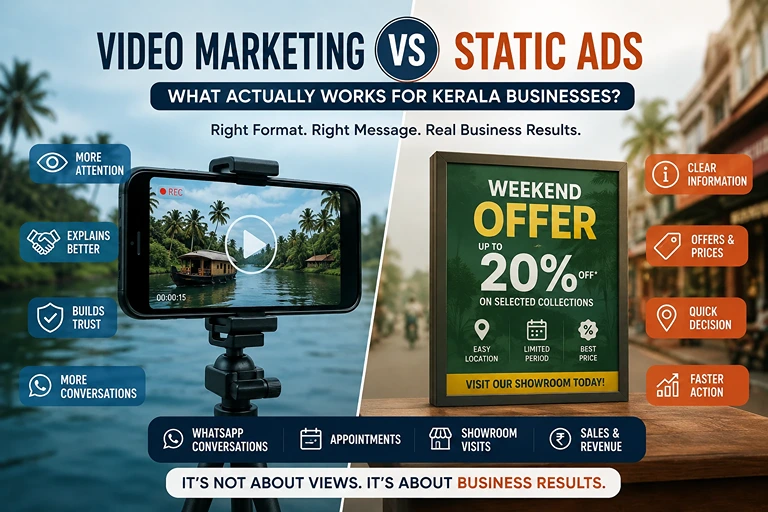
A Reel can get thousands of views, but posting Reels every day is not enough to grow a local business.
A poster can look professional and still fail to generate a sale.
Attention matters, but it is only the first step.
For a Kerala business, the real result may be a WhatsApp conversation, phone call, appointment booking, showroom visit, property enquiry, course admission, or completed sale.
Views and likes show that people noticed the creative. They do not prove that the right customers took action.
That is the real question in the video marketing vs static ads discussion.
The format is not the strategy. The customer’s doubt is the strategy.
The Format Should Match the Customer’s Doubt
Before choosing a Reel, poster, carousel, or short video, ask one question:
What is stopping the customer from taking the next step?
A customer may like the product but wonder whether the business is genuine.
Another may already trust the brand but need today’s price.
A third customer may want to visit but may not know where the showroom is located, whether parking is available, or whether the offer applies to the nearest branch.
These are different buying barriers. They should not be answered with the same creative format.
A jewellery customer may want to see how an ornament looks when worn.
A resort customer may want to see the road, parking, room size, washroom condition, and actual property experience.
A training-centre lead may want to understand who the course is for, what happens inside the classroom, and what support students receive.
In these situations, video can answer several practical questions quickly.
But when a restaurant needs to publish today’s menu, or a textile shop wants to announce a weekend offer, a clear static ad may do the job better.
The customer does not need a story. The customer needs the information.
A static ad is not weak because it does not move. A Reel is not automatically a sales creative.
The right format is the one that removes the most important buying barrier with the least confusion.
Video vs Static Results in the Same Campaign
When video and static ads run inside the same campaign, the result should not be judged only through reach, views, engagement, or total lead count.
A video may generate more attention and more enquiries because it explains the product or service in greater detail.
A static creative may generate fewer leads, but those leads may have stronger intent because the price, offer, date, location, or next step is immediately clear.
For example:
- Video may generate more WhatsApp conversations.
- Static may generate fewer but more qualified conversations.
- Video may have a lower cost per lead.
- Static may have a lower cost per interested lead or sale.
- Video may create stronger trust.
- Static may produce faster action from warm audiences.
The winning creative should therefore be identified using:
- Qualified lead volume
- Cost per qualified lead
- Interested and highly interested leads
- Appointment bookings
- Showroom visits
- Sales
- Revenue
- Production cost
A creative that generates 100 low-quality leads is not automatically better than a creative that produces 30 serious enquiries and 10 sales.
Addox Point of View
The best creative is not the one that generates the highest engagement. It is the one that creates the strongest business action at a sustainable cost.
The SEE–KNOW–TRUST–ACT Framework
Addox Digital uses a simple framework to decide which format should be used.
SEE
Use video when customers need to see the product, place, process, movement, scale, texture, layout, or transformation.
A textile showroom can show how fabric falls, how colours look under natural light, and how the material looks on a person.
A furniture business can demonstrate how a mechanism works instead of depending on a single product photo.
A home-service company can show the original problem, the technician, the work process, and the final result.
Static can attract attention, but video gives customers more visual evidence.
KNOW
Use video when customers need an explanation before they enquire.
A training centre may need to explain:
- Who the programme is for
- What happens during class
- What practical support is included
- How students are prepared for employment
The goal is not to include every detail in one video.
The goal is to answer the question most likely to delay the enquiry.
More information does not always improve conversion. The right information does.
TRUST
Use video when customers need proof that the business, team, service, facility, or product quality is reliable.
Real staff, actual premises, customer experiences, process footage, branch locations, and completed work can reduce hesitation.
For local businesses, practical footage can create more trust than an expensive cinematic video.
Showing the entrance, parking area, nearby landmark, classroom, showroom, technician, delivery process, or real product may improve lead quality.
Video should remove doubt, not simply add entertainment.
ACT
Use static ads when the customer mainly needs a clear reason or instruction to act.
Static works well for:
- Prices
- Dates
- Offers
- Menus
- Timings
- Stock updates
- Appointment slots
- Branch announcements
- Admission deadlines
- Booking instructions
The customer can scan, save, and return to the information without waiting for every detail to appear on screen.
Many buying journeys require both formats.
Video may handle SEE, KNOW, and TRUST.
Static creative may handle ACT.
What Is the Best Video Format?
There is no single video format that works for every business.
However, for most Kerala local-business performance campaigns, a short, vertical, mobile-first video is a strong starting point.
A practical format is:
Customer doubt → Clear answer → Real proof → Specific action
The video should quickly show the product, service, person, location, process, or result.
It should not begin with a long logo animation, generic welcome message, or unrelated cinematic footage.
The first few seconds should immediately tell the target customer why the video matters.
For example:
Hook: “Course complete ചെയ്തിട്ടും job കിട്ടുമോ എന്ന tension ഉണ്ടോ?”
Answer: Explain the practical training, internship exposure, interview preparation, or placement support.
Proof: Show the trainer, classroom, projects, mock interviews, and real student activity.
Action: “Upcoming batch details അറിയാൻ WhatsApp ചെയ്യൂ.”
The best video is not necessarily the most cinematic one.
It is the video that helps the customer make a decision quickly.
What Type of Hook Works Best?
A strong hook should begin with the customer’s pain point, doubt, desire, buying situation, or common mistake.
Weak hook:
“Welcome to our company.”
Stronger hooks:
- “Roof tile വാങ്ങുന്നതിന് മുമ്പ് ഈ difference അറിയണം.”
- “MBA join ചെയ്യാൻ planning ഉണ്ടോ? College select ചെയ്യുന്നതിന് മുമ്പ് ഇത് check ചെയ്യൂ.”
- “ഈ ornament wear ചെയ്താൽ എങ്ങനെ look ചെയ്യും?”
- “Resort book ചെയ്യുന്നതിന് മുമ്പ് road access check ചെയ്തോ?”
- “Ads run ചെയ്യുന്നുണ്ടെങ്കിലും quality leads കിട്ടുന്നില്ലേ?”
- “Course complete ചെയ്തിട്ടും interview confidence ഇല്ലേ?”
A strong hook should make the target customer feel:
“This video is for someone like me.”
The hook should not simply attract more viewers. It should attract the right potential customer.
Malayalam vs English: Which Works Better?
For Kerala-focused campaigns, Malayalam or natural Manglish often creates stronger relatability because it matches how customers communicate during calls, showroom visits, and WhatsApp conversations.
However, Malayalam will not automatically perform better in every campaign.
Malayalam may work well when:
The audience is primarily local
The service needs trust and explanation
The customer naturally speaks Malayalam
The campaign targets families or general consumers
Manglish may work well when customers already combine Malayalam with common English product or service terms.
English may perform better when:
The audience is professional or corporate
The campaign targets NRIs
The service is technical
The brand has a premium or international positioning
English terminology is normal in the industry
The right approach is to test separate versions under similar campaign conditions.
For example:
Malayalam speech with English industry terms
Natural Manglish delivery
English video with Malayalam captions
Separate Malayalam and English creatives
The winning language is not the one that produces more views.
It is the one that generates better qualified leads, bookings, and sales.
Simple Phone Video vs Professional Video
A simple phone video can outperform a professionally produced video.
This usually happens when the phone video feels real, direct, relevant, and trustworthy.
Phone videos can work well for:
- Founder explanations
- Expert advice
- Product demonstrations
- Customer FAQs
- Showroom walkthroughs
- Location guidance
- Classroom content
- Behind-the-scenes footage
- Before-and-after results
- Service-process videos
Professional video is valuable when visual quality strongly affects the buying decision.
This may apply to:
- Jewellery
- Luxury property
- Resorts
- Architecture
- Interior design
- Premium fashion
- Automobiles
- High-value brand campaigns
However, expensive production cannot compensate for a weak hook, unclear offer, irrelevant message, or vague call to action.
Addox Point of View
Use authenticity for performance. Use professional production when presentation itself affects trust, value perception, and buying decisions.
A phone video should still have clear audio, stable footage, sufficient lighting, readable captions, and clean framing.
Authentic does not mean careless.
Why Do Videos Fail?
Videos commonly fail because:
- The opening is weak
- The video starts with a long logo animation
- The hook attracts viewers but not buyers
- The customer’s main doubt is not answered
- Too many messages are included in one video
- The offer, price, eligibility, location, or next step is unclear
- The footage looks attractive but provides no practical evidence
- Audio quality is poor
- Captions are missing or unreadable
- The video is longer than necessary
- The language feels forced
- The call to action is vague
- The creative reaches the wrong audience
- Lead follow-up is weak
- Conversion tracking is incomplete
A video may also appear to fail when the actual problem happens after the enquiry.
The business may reply slowly.
The WhatsApp response may be unclear.
The quotation may arrive late.
The sales team may fail to follow up.
These are not creative problems, but they affect the campaign result.
How to Test Video and Static Fairly
When the winning format is unclear, test both under similar conditions.
Keep the following factors the same:
- Offer
- Audience
- Campaign objective
- Budget
- Campaign period
- Call to action
- Landing page or WhatsApp destination
- Service area
Both creatives should communicate the same core message.
The main difference should be the format.
Track:
- Total leads
- Qualified leads
- Cost per qualified lead
- Calls
- WhatsApp conversations
- Bookings
- Showroom visits
- Sales
- Revenue
- Production cost
Do not declare a winner based only on views, reach, engagement, or total lead volume.
Cost per qualified lead and lead quality should be reviewed together.
reviewed together.
The Creative Is Only the First Step
The complete journey is:
Creative → Click or Enquiry → WhatsApp or Call Handling → Lead Qualification → Follow-Up → Booking or Store Visit → Sale
A strong video can generate interest and still fail to produce revenue.
Offer clarity, pricing, customer reviews, landing-page experience, call quality, response speed, and follow-up also influence conversion.
Businesses should record:
- Which creative produced the enquiry
- Whether the lead was qualified
- Whether the customer booked or visited
- Whether the enquiry produced a sale
The problem is not always the advertisement.
Sometimes the advertisement works, but the sales process loses the lead.
Final Recommendation
Use video when customers need to:
- See the product or place
- Understand the service
- Watch a demonstration
- Evaluate the process
- Trust the people behind the business
Use static creative when customers need:
- A clear price
- An offer
- A date
- A deadline
- A menu
- A reminder
- A location
- An availability update
- A booking instruction
Use both when the customer journey contains several buying barriers.
Addox Digital’s Final Point of View
Use video when customers need to:
- See the product or place
- Understand the service
- Watch a demonstration
- Evaluate the process
- Trust the people behind the business
Use static creative when customers need:
- A clear price
- An offer
- A date
- A deadline
- A menu
- A reminder
- A location
- An availability update
- A booking instruction
Use both when the customer journey contains several buying barriers.