Marketers are being told that SEO is fading, AEO is
essential, and GEO is the next major growth channel.
The result is more confusion than strategy.
SEO is not becoming obsolete. AEO and GEO are useful
extensions of modern search marketing, not replacements for it. SEO helps a
page get found. AEO helps its answer get understood. GEO improves the evidence
and authority that may make the content worth referencing.
But visibility is only the beginning.
A ranking, featured answer, brand mention, or AI citation
has limited value unless it contributes to qualified traffic, sales opportunities, or revenue.
This guide explains AEO
vs GEO vs SEO, how the three approaches connect, and where businesses
should invest first.
AEO vs GEO vs SEO: Quick Comparison
| Approach | Main Purpose | What It Improves | Key Measures | Prioritize When |
|---|---|---|---|---|
| SEO | Help pages get discovered | Indexing, rankings, relevance, organic traffic | Rankings, impressions, qualified visits | Important pages are not visible or attract the wrong audience. |
| AEO | Help content answer questions clearly | Definitions, summaries, comparisons, FAQs | Answer visibility and engagement | Pages get impressions but do not answer quickly. |
| GEO | Improve readiness for AI-generated answers | Originality, evidence, authority, citations | AI mentions, citations, citation accuracy | Strong pages are indexed but rarely referenced. |
The three approaches overlap. A strong commercial page can support all of them.
What SEO, AEO and GEO Mean
SEO, or search engine optimization, helps search engines find, understand, index, and rank a page for relevant searches. Its business purpose is to connect real demand with the company’s products, services, or expertise.
SEO covers technical eligibility, search intent, useful content, internal links, and organic performance. It remains the foundation because a page cannot perform if search systems cannot access or understand it.
AEO, or answer engine optimization, improves how clearly a page responds to a specific question. It uses direct answers, descriptive headings, simple definitions, comparisons, and focused FAQs to help readers reach the main point faster.
AEO should not reduce every topic to shallow fragments. The answer must still contain enough context to help the reader make a decision.
GEO, or generative engine optimization, improves how content may be understood, trusted, and referenced within AI-generated answers. Its main areas are original information, credible evidence, and accurate citation monitoring.
GEO cannot guarantee a citation. AI-generated answers can change across platforms, prompts, models, locations, and dates. It should be treated as a content-quality and measurement discipline, not a guaranteed ranking formula.
The Four-Layer Search Visibility Model
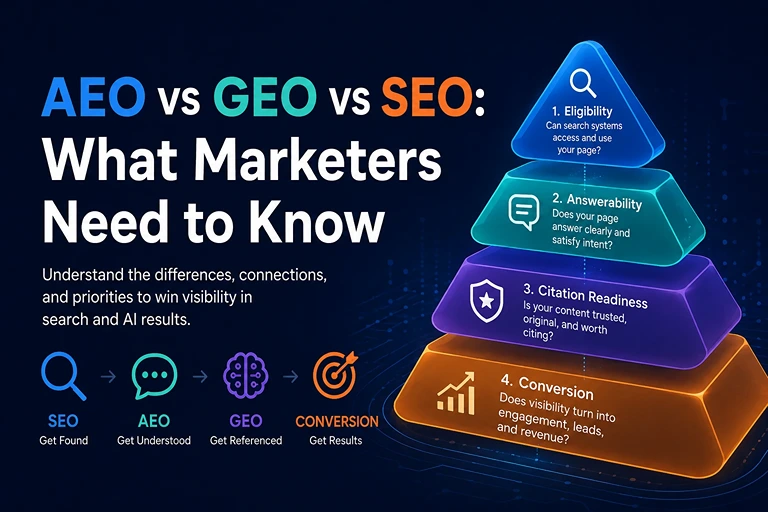
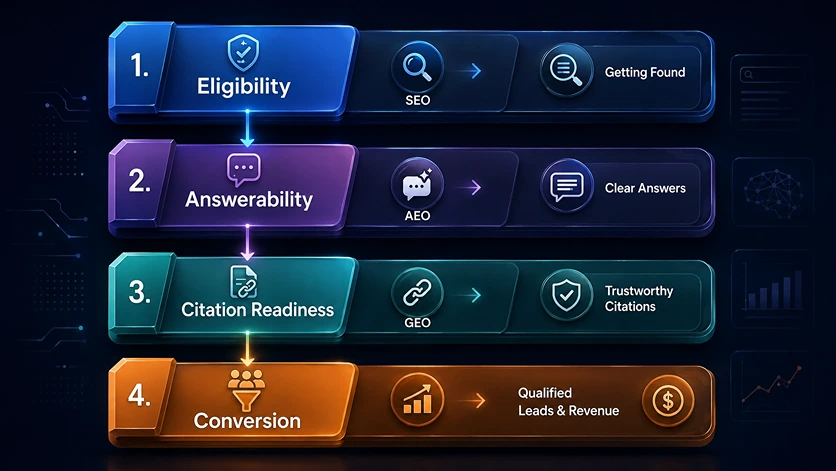
The clearest way to approach search today is through four connected layers:
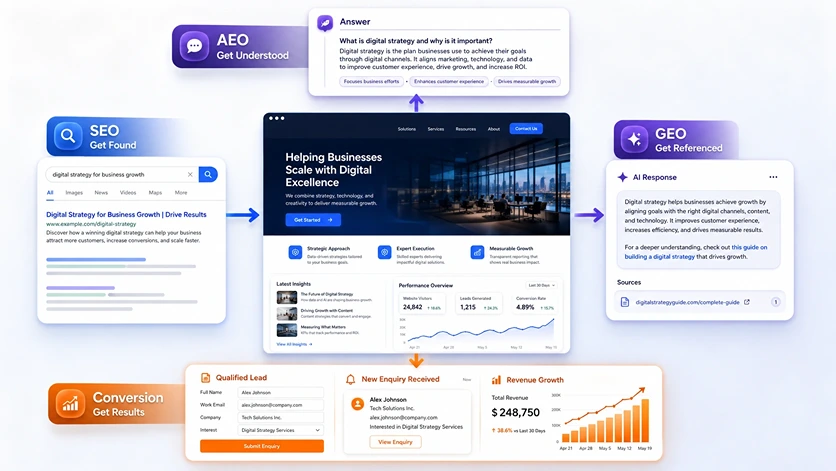
- SEO helps the page get found.
- AEO helps the answer get understood.
- GEO helps the content become worth referencing.
- Conversion turns visibility into business value.
1. Eligibility
Eligibility asks whether search systems can access and use the page.
First, confirm that the page can be crawled, indexed, reached through internal links, and recognised as the correct canonical version. The main content should also be available as readable text and work properly on mobile devices.
The business implication is simple: improving answers or evidence has limited value when an important page is not eligible to appear in search.
Google’s guidance for AI-supported search also keeps normal technical SEO at the centre. Pages generally need to meet standard search requirements before they can appear as supporting sources in AI-generated results.
In practice, marketers should diagnose eligibility before rewriting content. If a priority page receives no impressions, is excluded from the index, or is difficult to reach through the site structure, technical access is the first problem to solve. This prevents teams from spending time improving a page that search systems may not be able to retrieve reliably.
2. Answerability
Answerability asks whether the page gives a clear response without forcing the reader to search for it.
Check that the main answer appears early, headings reflect real questions, important terms are explained, and options or limitations are easy to understand.
This is where AEO has the strongest role.
A page can rank and still disappoint the reader. Long introductions, vague headings, and hidden conclusions create friction. Clear answers help potential buyers understand the issue and move towards a decision.
A useful answer pattern is simple: state the conclusion first, explain the reasoning, add evidence or an example, and then show the next step. This gives a busy decision-maker a quick answer without removing the depth needed by a reader who wants to evaluate the recommendation carefully.
3. Citation Readiness
Citation readiness asks whether the page contains information worth referencing.
Strong citation-ready content usually combines original information, credible evidence, and transparent context. It may include first-party observations, a named expert reviewer, reliable sources, visible dates, or a clear explanation of how a conclusion was reached.
Generic content is easy to replace. Distinctive and well-supported content is more useful to both readers and AI systems.
This does not always require a major research project. A company can add value through practical comparisons, clear processes, local market context, or verified expert observations.
The business implication is stronger trust. Better evidence can also improve the chance that the brand is represented accurately when a system uses the page as a source.
A practical way to review citation readiness is to test every important claim against five questions: Who is making the claim? What evidence supports it? When was the information checked? How was the conclusion reached? What limitation should the reader know? A page does not need all five answers in every paragraph, but important commercial claims should be easy to verify.
4. Conversion
Conversion asks whether the right reader has a useful next step.
The page should connect naturally to a commercially relevant action, show why the company is qualified to help, provide a simple enquiry path, and allow lead quality to be measured.
A page can rank or earn citations without producing meaningful business action.
Visibility should support qualified traffic, enquiries, opportunities, or revenue. Anything less is an incomplete result.
The conversion action should also match the reader’s stage. An early-stage reader may need a checklist or comparison guide, while a decision-stage buyer may be ready for an audit, assessment, pricing discussion, or consultation. Matching the CTA to intent usually creates a better path than sending every reader to the same generic contact form.
Which approach should marketers prioritize?
Start with the weakest layer.
First, fix technical eligibility. Next, improve the clarity of the answer. Then strengthen the evidence and trust behind it. Finally, make sure the page gives the reader a relevant conversion path.
For most companies, SEO should receive the first investment because it supports everything that follows. AEO and GEO become more valuable when important pages are already accessible, commercially relevant, and built around real customer questions.
How to Optimize One Page for All Three
Imagine an Indian software company publishing a page titled:
“How Much Does Multi-Location Reporting Software Cost in India?”
The existing page describes the product but does not answer the pricing question.
For SEO, the company should make sure the page is indexable, linked from relevant product pages, and focused on one clear search intent. The title, heading, URL, and internal links should support the same topic.
For AEO, the page should open with a direct answer:
Multi-location reporting software pricing depends on the number of locations, users, integrations, onboarding requirements, and support level. Businesses should compare total implementation cost, not only the monthly licence fee.
A short table could then explain the main cost factors.
For GEO, the page should add a named reviewer, a visible update date, credible supporting sources, Indian tax or implementation context, and a transparent method for any estimate. Planning assumptions must be labelled as estimates rather than market facts.
For conversion, the page should offer a budgeting worksheet, requirements assessment, or pricing consultation.
The result is one stronger page—not separate SEO, AEO, and GEO versions.
The page should then be reviewed as a complete journey. The title must match the question, the opening answer must reduce uncertainty, the evidence must make the claim believable, and the CTA must help the right prospect continue. Adding more words is not the goal; removing the gaps between discovery, understanding, trust, and action is.
How to Measure Search and AI Visibility
Measure performance in three groups.
Visibility
- Rankings and impressions
- AI mentions
- AI citations
- Citation accuracy
Engagement
- Website visits
- Engaged sessions
- Commercial-page visits
- Resource downloads
Business outcomes
- Qualified enquiries
- Sales opportunities
- Pipeline
- Revenue
A brand mention is not a citation. A citation is not a visit. A visit is not a lead.
AI visibility also needs careful testing. Record the platform, prompt, location, and date, then repeat the test with more than one prompt variation.
One screenshot may show an interesting result. It is not reliable proof of stable visibility.
Create a baseline before making major changes. Track the same priority pages and prompt set over a consistent review period, then compare changes in visibility, engagement, and qualified enquiries. This makes it easier to distinguish a temporary citation from a repeatable improvement.
Measurement should also remain page-specific. When a page earns visibility, check whether users reach the intended commercial content, take the expected next step, and meet the company’s lead criteria. This connects search reporting with sales reality instead of treating every click or mention as equal.
Three Common Mistakes Marketers Should Avoid
1. Treating GEO as a replacement for SEO
AI-supported discovery still depends on accessible, indexable, useful content. GEO should strengthen a sound SEO strategy, not replace it.
2. Looking for shortcuts
Creating separate pages for every prompt variation usually adds duplication rather than value. Structured data and files such as `llms.txt` may serve specific technical purposes, but they do not guarantee AI citations or visibility. Strong content and technical eligibility still matter more.
3. Measuring visibility without business context
Marketers should not report mentions as citations or citations as leads. They should also check citation accuracy, repeat prompt tests, and assess whether the visibility relates to a useful landing page or commercial question. AI-assisted content must never claim experience or results that did not happen.
A Practical 90-Day Action Plan
Days 1–30: Audit
- Select priority commercial pages
- Check technical eligibility and search performance
- Test relevant AI prompts
- Review conversion paths
Days 31–60: Improve
- Rewrite weak answers
- Add credible evidence
- Improve internal links
- Align CTAs with reader intent
Days 61–90: Measure
- Repeat visibility tests
- Compare engagement
- Review lead quality
- Expand changes that produce business value
Start with existing commercial pages before producing a large volume of new content.
During the first month, the goal is not to fix everything; it is to identify the pages with the strongest combination of commercial importance and improvement potential. In the second month, focus on a manageable group of priority pages so every change can be reviewed properly. In the final month, compare results against the baseline and document which changes should be repeated, refined, or stopped.
By day 90, the team should have more than a list of rankings or AI screenshots. It should have a repeatable page-review process, clearer evidence standards, a practical prompt-testing method, and a stronger connection between search visibility and lead quality.
Frequently Asked Questions
No. GEO focuses on evidence and citation readiness within AI-generated answers. SEO remains the foundation for technical access, relevance, authority, and organic visibility.
No. GEO can improve the quality and credibility of a page, but AI answers can change across platforms, prompts, and dates.
Small businesses should first make sure their important pages are technically sound, useful, and commercially focused. GEO becomes worthwhile when the business has credible expertise or original information that can strengthen those pages.
AEO improves how clearly a page answers a specific question. GEO strengthens the evidence, authority, and context that may make that answer useful as a source in AI-generated results.
No special schema or AI file guarantees inclusion in Google’s AI features. Accurate structured data can still help search engines understand visible content, but technical eligibility and content quality remain more important.
A monthly baseline is practical for most B2B teams, with more frequent checks for fast-changing topics. Record the platform, prompt, location, and date so results can be compared consistently.
The debate around AEO vs GEO vs SEO becomes simpler when each approach has a clear job.
SEO remains the foundation. AEO improves answer clarity. GEO strengthens evidence, authority, and citation readiness. Conversion remains the final business goal.
A page should not be judged only by rankings, traffic, or AI visibility. It should also be judged by the quality of the audience it attracts and whether that attention contributes to enquiries, opportunities, or revenue.
Your website may already rank on Google—but does it appear clearly in search answers and AI-generated results?
Request an SEO, AEO and GEO visibility audit from Addox Digital to identify where your website is losing visibility, trust, or qualified leads.
Turn Search Visibility Into Business Growth
SEO helps you get found. AEO helps you get understood. GEO helps you get referenced. Addox brings all three together to generate qualified leads and measurable growth.
Book a Free Consultation