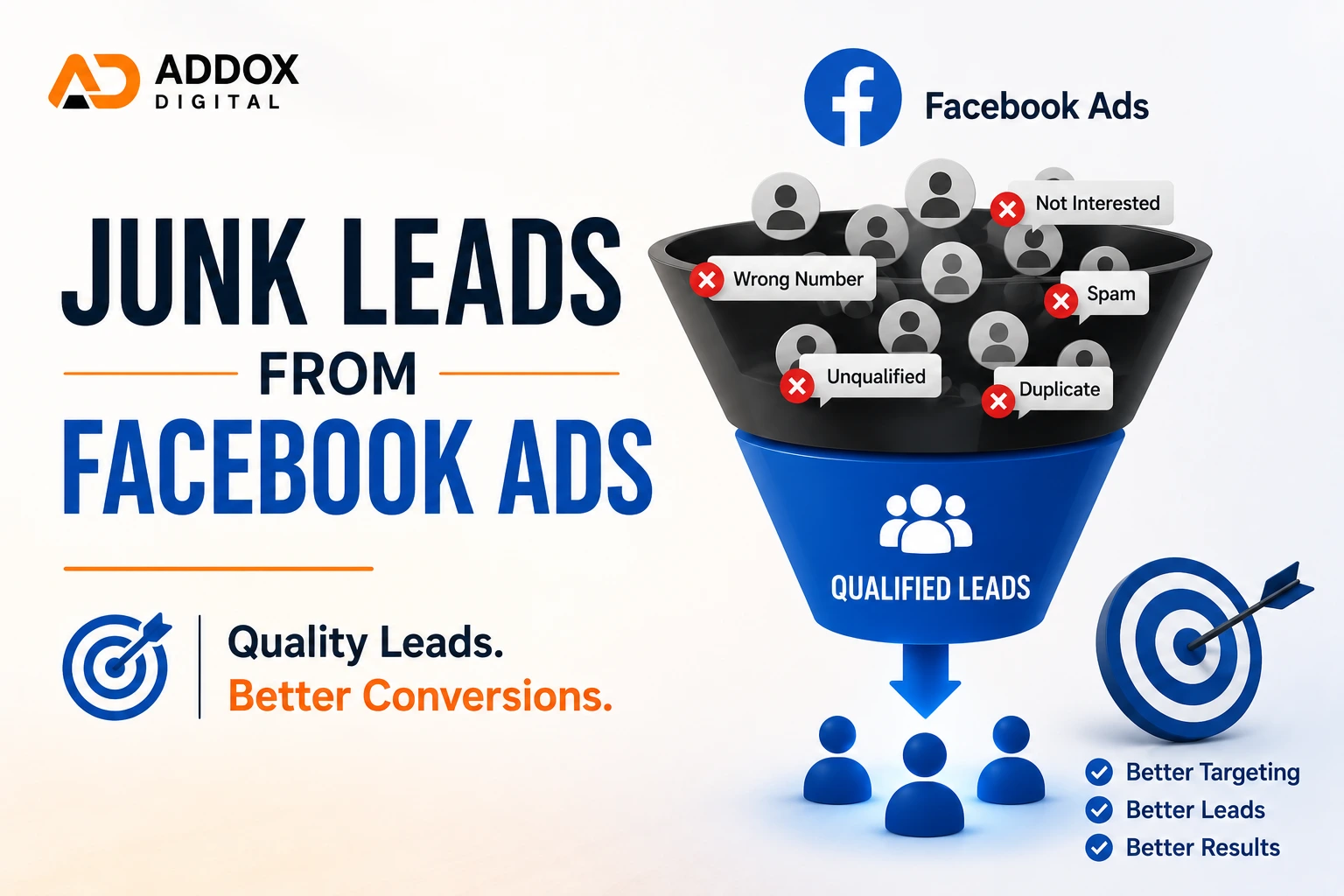
Junk leads from Facebook ads can make a campaign look successful while quietly wasting budget, sales time, and follow-up effort.
Many businesses see high lead volume from Facebook and Instagram campaigns. But not every lead is useful. Some people submit forms by mistake. Some give wrong phone numbers. Some are outside the service area. Some only want free information and have no plan to buy.
That is why cost per lead alone can mislead you. A low-cost lead is not valuable if your team cannot contact, qualify, or convert that person.
The real goal is not just more leads. The goal is more qualified leads: people who match your offer, have a real need, can be contacted, and are likely to take the next step.
Facebook ads junk leads are a profit leak
A cheap lead becomes expensive when it cannot be contacted, qualified, or converted.
Facebook Ads can generate a high volume of leads, but not all of them are qualified. Many businesses struggle with junk leads: accidental form submissions, incorrect contact details, weak intent, or users who do not understand the offer.
This affects more than the ad budget. It also affects the sales team. Every bad lead takes time to call, follow up, update in a CRM, and report. If your team spends hours chasing people who never intended to buy, your real campaign cost is much higher than the ad dashboard shows.
Meta’s lead ads with instant forms are designed to collect lead information directly from ads, which makes submission easier for users. That ease can help volume, but it can also increase weak submissions when forms are too simple.
Local trade-off: For Indian service businesses, a low CPL can look attractive. But if many leads are students, price shoppers, wrong-location users, or people outside the buying stage, the campaign may still lose money.
Unpopular truth: Junk leads usually increase when businesses optimize for lead count instead of lead quality.
How do you reduce junk leads from Facebook ads?
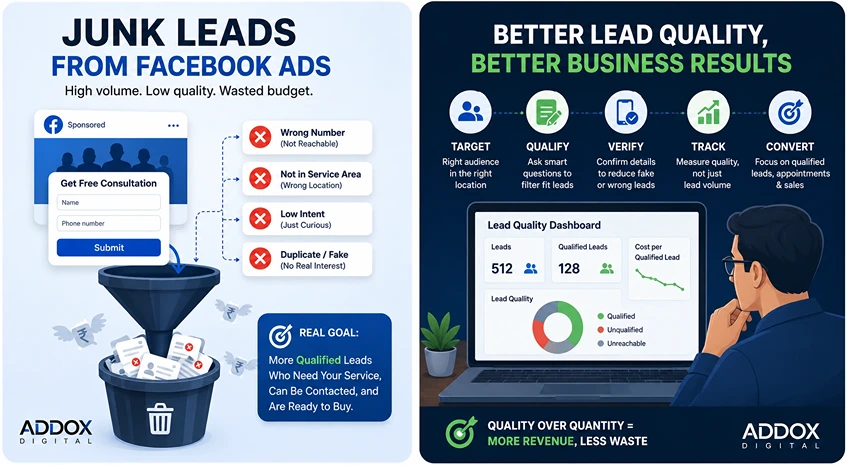
Reduce junk leads by filtering users before, during, and after form submission.
To reduce junk leads from Facebook ads, improve five things: targeting, ad copy, form questions, verification, and sales tracking.
First, target people who actually match your buyer profile. Avoid overly broad audiences unless your offer has mass appeal. Use serviceable locations, relevant age groups, suitable language, and exclusions where needed.
Second, make the ad copy clear. Say who the offer is for, what problem it solves, who should not apply, and what happens after the user submits the form. Vague offers like “Get free consultation” often bring curious users, not serious buyers.
Third, add qualifying questions. Meta allows advertisers to add custom questions to instant forms, which helps collect more than basic name, phone, and email details. Ask about service need, location, timeline, budget range, and preferred contact time.
Fourth, use verification when needed. Phone confirmation, WhatsApp confirmation, or callback scheduling can reduce wrong numbers and accidental submissions. This adds friction, so use it when sales time is valuable or the offer is high-ticket.
Fifth, track quality after the lead arrives. HubSpot defines lead conversion as moving a contact into a qualified opportunity, deal, or paying customer. That means the real metric is not only CPL. It is cost per qualified lead, cost per appointment, and cost per sale.
Main recommendation:
Do not judge Facebook ads only by the number of leads. Judge them by how many leads become qualified conversations, booked appointments, and paying customers.
Do this now:
- Step 1: Export your last 100 Facebook leads.
- Step 2: Mark each one as qualified, unqualified, unreachable, wrong number, duplicate, or converted.
- Step 3: Check which campaign, ad set, creative, and form produced the weakest leads.
- Step 4: Add one qualifying question before increasing budget.
- Step 5: Review quality weekly, not only lead volume.
Proof you keep: Lead-quality sheet, call status, campaign name, date, spend, and qualified lead count.
Why do Facebook ads generate junk leads?
Junk leads rise when the campaign removes too much friction from the user journey.
Facebook and Instagram are scrolling platforms. People are often not actively searching for your service. They may see an ad, tap quickly, and submit a form without fully reading the details.
Instant forms make this even easier because users can submit details inside the Meta environment. This helps reduce effort, but it can also attract people who are curious rather than serious. Meta’s instant form setup supports lead capture inside ads, so the advertiser must design the form carefully.
Common reasons for junk leads include:
- Broad targeting
- Weak ad copy
- No price or eligibility clue
- Too few form questions
- Auto-filled user details
- No location filter
- No follow-up process
- No CRM quality feedback
- No clear consent or callback message
Unpopular truth: Many junk leads are created before the sales call. The campaign failed to filter the wrong people early.
Are instant forms worse than landing pages?
Instant forms usually improve volume; landing pages usually improve intent.
Instant forms are not bad. They are useful for simple offers, local services, event signups, demos, and quick enquiries. The issue is that simple forms can create low-intent leads when the user does not get enough context before submitting.
Landing pages often bring better intent because users must leave the feed, read more, understand the offer, and then submit. That extra step can reduce total leads, but it often improves lead seriousness.
Meta also supports conditional logic in instant forms, where the form can change questions or outcomes based on earlier answers. This helps qualify leads before they reach your sales team.
Option | Best for | Trade-off | Date |
Instant form | High-volume lead capture | More accidental or low-intent submissions | 2026-05-30 |
Higher-intent instant form | Balanced volume and quality | Fewer leads than simple forms | 2026-05-30 |
Landing page form | Complex or high-ticket offers | Higher cost per lead, better context | 2026-05-30 |
WhatsApp or call lead | Fast local follow-up | Needs trained sales handling | 2026-05-30 |
Practical rule:
Use instant forms when the offer is easy to understand. Use landing pages when the buyer needs proof, pricing, FAQs, case studies, or detailed explanation.
What form questions reduce junk leads?
Good form questions qualify need, location, budget, timing, and decision readiness.
A weak form asks only for name and phone number. A stronger form helps you understand whether the person is a fit.
Useful Facebook lead form questions include:
- Which service do you need?
- What is your location?
- When do you want to start?
- What is your estimated budget?
- Are you the decision-maker?
- What time should we call you?
- Have you used this service before?
- What problem are you trying to solve?
Meta allows custom questions in instant forms, so businesses can collect more relevant information from leads before calling them. Meta also supports conditional answers, where answer choices can change based on a previous response.
Trade-off: Every extra question may reduce lead volume. But when your main issue is junk leads, this is often a good trade.
Example:
Instead of asking only “Name and phone number,” a real estate campaign can ask:
- Which location are you interested in?
- What is your budget range?
- Are you looking to buy within 30, 60, or 90 days?
- Do you want a site visit?
These questions reduce casual submissions and help the sales team prioritize serious prospects.
How should targeting change when lead quality is poor?
Better targeting starts by excluding poor-fit users, not only adding more interests.
When lead quality is poor, many advertisers simply add more interests. That may help, but it is not enough. You also need to exclude people who are unlikely to buy.
Improve targeting by reviewing:
- Serviceable cities, districts, or radius
- Age groups that match actual buyers
- Language used by your sales team
- Existing customer lists
- Website visitor audiences
- Engaged Instagram and Facebook audiences
- Lookalike audiences where suitable
- Exclusions for existing customers, job seekers, or irrelevant groups
Local example:
A clinic in Kochi may get cheaper leads from far-away areas, but those users may never visit. A tighter location radius can increase CPL but improve appointment quality.
Unpopular truth: A smaller audience can be more profitable when the offer depends on location, trust, budget, or urgency.
How do you measure lead quality instead of only CPL?
Cost per qualified lead is more useful than cost per raw lead.
CPL means cost per lead. It shows how much you paid for one form submission. But it does not show whether that person answered the phone, needed your service, had the right budget, or became a customer.
Track these metrics instead:
- Contact rate: how many leads answered calls or replied
- Qualification rate: how many matched your buyer criteria
- Appointment rate: how many booked a call, visit, demo, or consultation
- Sales rate: how many became customers
- Cost per qualified lead: ad spend divided by qualified leads
- Cost per sale: ad spend divided by actual customers
HubSpot’s lead conversion definition focuses on contacts becoming qualified opportunities, deals, or paying customers. That supports tracking real movement in the sales process, not only form submissions.
Do this now:
- Step 1: Add a “lead status” column in your CRM or spreadsheet.
- Step 2: Use fixed labels: New, Contacted, Qualified, Not Qualified, Wrong Number, Duplicate, Converted.
- Step 3: Review status by campaign, ad set, creative, and form.
- Step 4: Move budget toward sources with better qualified lead cost.
Proof you keep: CRM screenshot, weekly lead-quality report, call status, and campaign spend export.
Should you use phone verification or WhatsApp confirmation?
Verification improves contact quality but can reduce total lead volume.
Phone verification, OTP checks, WhatsApp confirmation, and callback scheduling can reduce fake numbers and accidental submissions. These filters work best when each qualified lead has high value.
Use verification when:
- Wrong numbers are common
- Sales team time is limited
- The offer is expensive
- Appointments matter more than raw enquiries
- You need stronger consent records
- Follow-up cost is high
Privacy also matters. A 2026 academic study on the lead marketing ecosystem found risks related to personal data collection, brokerage, and spam-like consumer contact. That means businesses should collect only needed data, explain follow-up clearly, and avoid sharing lead data without proper consent.
Trust note:
Tell users what will happen after they submit. Example: “Our team will call you within one working day to confirm your requirement.”
What role does ad copy play in lead quality?
Clear ad copy filters weak users before they reach the form.
Ad copy should not attract everyone. It should attract the right person and discourage the wrong person.
Weak copy says:
“Get free consultation today!”
Better copy says:
“For Calicut business owners spending ₹30,000+ per month on ads and needing better lead quality. Request a campaign review.”
Good ad copy includes:
- Who the offer is for
- Location served
- Basic price or budget clue
- Eligibility requirement
- Clear next step
- Expected callback time
- No exaggerated promises
Trade-off: Clearer copy may reduce clicks. But it can improve the quality of people who submit the form.
When should you switch from instant forms to landing pages
Switch to landing pages when users need education before they become qualified leads.
Use a landing page when the offer is complex, expensive, sensitive, or trust-based. A landing page gives you space to explain the service, show proof, answer objections, and add better qualification.
Switch from instant forms when:
- Many leads are unreachable
- Users ask, “What is this about?”
- Sales teams reject most leads
- Users are outside the service area
- The offer needs pricing explanation
- The buyer needs testimonials or case studies
- You need better tracking and remarketing
Landing pages are especially useful for services like real estate, clinics, finance, education, B2B services, and high-ticket consulting.
Unpopular truth: A higher CPL can be better if the landing page produces leads that actually convert.
Common mistakes that create junk Facebook leads
Most bad lead campaigns optimize for form submissions instead of buyer intent.
Here are the most common mistakes:
- Running broad targeting without exclusions
- Using vague offers like “free consultation”
- Asking only for name and phone number
- Hiding price or eligibility details
- Targeting areas the business cannot serve
- Using instant forms for high-ticket offers without enough context
- Calling leads too late
- Not tracking wrong numbers or unreachable leads
- Reporting only CPL to clients or management
- Not connecting campaign data with sales results
Red flag:
If the campaign has a very low CPL but the sales team says “these leads are useless,” the campaign is probably optimized for cheap submissions, not serious prospects.
Fix:
Pause the weakest ad sets, add qualifying questions, improve ad copy, and track cost per qualified lead.
The cheap lead campaign that failed sales
Lead quality improves when campaigns are judged by sales outcomes, not dashboard volume.
During a campaign review for a local service business, the Facebook dashboard looked positive. CPL was low. Lead volume was high. On paper, the campaign looked ready to scale.
The sales log told a different story.
Many numbers were unreachable. Some users said they clicked by mistake. Others were outside the service area. A few were students collecting price details. The issue was not that Facebook could not generate leads. The issue was that the campaign asked too little before sending people to sales.
The fix was simple:
- Add service-area wording in the ad
- Add a budget-range question
- Add a start-timeline question
- Add preferred callback time
- Move high-ticket traffic to a landing page
- Report cost per qualified lead weekly
Lead volume dropped, but the sales team spent less time on weak prospects. That is a good result when the goal is revenue, not just form submissions.
For Addox Digital, this is also the right client conversation: do not only show lead count. Show lead quality, follow-up quality, and sales movement.
The 5-filter framework for better Facebook lead quality
Better lead quality comes from filtering at targeting, message, form, verification, and CRM stages.
Filter | What to check | Effort | ROI horizon | Date |
Targeting filter | Location, buyer profile, exclusions | Medium | 2–4 weeks | 2026-05-30 |
Message filter | Clear offer, price clue, fit statement | Low | 1–2 weeks | 2026-05-30 |
Form filter | Custom questions, conditional logic | Low | 1–3 weeks | 2026-05-30 |
Verification filter | WhatsApp, OTP, callback slot | Medium | 2–6 weeks | 2026-05-30 |
CRM filter | Lead status and conversion feedback | Medium | 4–8 weeks | 2026-05-30 |
Use this framework before you increase budget. If your campaign cannot separate good leads from bad leads, scaling will only create more waste.
Do this now:
- Step 1: Choose one campaign with high junk lead complaints.
- Step 2: Add one filter at a time.
- Step 3: Compare CPL, contact rate, qualified lead rate, and sales rate.
- Step 4: Keep the filter only if lead quality improves.
Proof you keep: Before-and-after report with CPL, contact rate, qualified lead rate, and cost per qualified lead.
FAQs
You may be getting junk leads because your campaign is too easy to submit and too unclear about who should apply. Instant forms can bring volume, but weak questions attract low-intent users. Add location, budget, timeline, and service-fit questions.
Yes, Facebook lead ads can still work well. The key is to track qualified leads, not only CPL. Meta supports custom questions and conditional logic, which can help improve qualification before the sales team follows up.
Use instant forms when the offer is easy to understand and the user can decide quickly. Use a landing page when the service needs proof, pricing context, FAQs, testimonials, or detailed explanation. Landing pages may reduce lead volume but often improve intent.
Start with three to five questions. Ask about service need, location, timeline, budget, and preferred contact time. Too many questions can reduce submissions, but too few questions can overload your sales team with weak leads.
The best metric is cost per qualified lead. Also track contact rate, appointment rate, sales rate, and cost per sale. CPL is useful, but it does not prove that the lead is real, reachable, or ready to buy.
Yes. Addox Digital can help by reviewing targeting, ad copy, lead forms, landing pages, CRM tracking, and follow-up quality. The key is to connect ad performance with qualified conversations and sales outcomes.
Improve Lead Quality, Not Just Lead Volume
Many Facebook campaigns generate enquiries, but not all leads become customers. A better qualification process can help reduce wasted ad spend and improve conversion potential.
Get in Touch →