Your business is active on Instagram and Facebook.
You post reels, publish offers, share customer photos, and sometimes spend money on advertisements. Your page receives views, likes, and engagement.
But the WhatsApp inbox is still quiet.
The few inquiries you receive may not be serious. Some people ask for the price and disappear. Some do not answer calls. Others may be outside your service area or unsuitable for the service you provide.
This is when many business owners conclude that social media does not work.
In most cases, social media is not the actual problem.
The business may be creating content and running advertisements without having a connected lead-generation system.
A business can receive thousands of views without creating one genuine sales opportunity. It can also generate cheap leads that never move towards a purchase.
Reach is not revenue.
Effective social media lead generation in Perinthalmanna requires more than regular posting. Your customer targeting, content, offer, advertising, inquiry process, follow-up, and sales team must work together.
Here are the main reasons your Perinthalmanna business may not be getting leads from social media.
1. Your Content Is Created Only to Keep the Page Active
Many businesses prepare content because they believe something must be posted regularly.
Their monthly calendar may include:
- Festival posters
- Product images
- Team photos
- Motivational quotes
- Customer reviews
- Generic educational reels
- Weekend offers
The page remains active, but the content does not create demand.
Customers do not contact a business simply because it posts every day. They contact a business when its content helps them recognize a problem, understand a solution, and trust the company providing it.
A furniture business should not only publish images of sofas and dining tables. It can discuss space planning, material selection, durability, customization, and common furniture-buying mistakes.
A training institute should not only post classroom photos. It should address career confusion, lack of practical experience, job readiness, and placement concerns.
A construction company should not only display completed homes. It should explain budget control, project delays, material selection, site supervision, and remote project management.
Strong content begins with the customer’s situation.
Before creating the next post, ask:
What is our customer worried about, confused about, or trying to achieve?
This question produces better content than simply asking what should be posted today.
2. Your Message Sounds Like Every Other Business
Many businesses use similar marketing statements:
- Best quality
- Affordable price
- Trusted service
- Experienced team
- Professional support
- Customer satisfaction
- Advanced solutions
These phrases are easy to write, but they do not help customers understand what makes the business different.
When every business says it is experienced, trusted, and affordable, customers are left with no clear reason to choose one company over another.
A stronger message should explain the customer problem the business solves.
Instead of saying
We provide high-quality digital marketing services.
Say:
We help local businesses turn online attention into qualified inquiries and measurable sales opportunities.
Instead of saying
We offer professional home construction services.
Say:
We help homeowners manage planning, site coordination, budget decisions, and project communication from start to completion.
Specific messages create clarity.
Generic messages create similarity.
If your content can be copied by several competitors without changing anything, it is not strongly positioned.
3. You Are Trying to Speak to Everyone
“Everyone in Malappuram” is not a target audience.
A parent searching for a career course, an NRI planning a house and a retailer trying to increase showroom visits do not have the same concerns.
They should not receive the same advertisement.
Many campaigns define the audience only using age, gender and location. These details may help with targeting, but they do not explain why someone would buy.
A useful customer profile should consider:
- Current situation
- Main problem
- Desired result
- Level of urgency
- Budget or eligibility
- Common objections
- Decision-making role
Consider a training institute.
Its audience may include:
- A Plus Two student confused about career options
- A graduate unable to find a suitable job
- A parent concerned about placements
- A working professional planning a career change
One common advertisement for all these groups may generate reach, but the message may not feel personally relevant to anyone.
The clearer the audience, the easier it becomes to create content and campaigns that generate meaningful responses.
4. Your Offer Gives People No Reason to Enquire
A service is not the same as an offer.
A service explains what the business provides.
An offer explains why the customer should take the next step.
For example:
Service: Interior design services.
Offer: Book an initial space-planning consultation for your new home.
Service: Digital marketing services.
Offer: Request a review of why your current social media campaigns are not producing qualified inquiries.
Service: Career training.
Offer: Check your eligibility for a practical program with live projects and placement support.
Many advertisements contain only a service name, logo, and phone number.
The customer is left with several questions:
- What exactly will I receive?
- Is this service suitable for me?
- What happens after I contact the business?
- What makes this different?
- Why should I take action now?
A strong offer should communicate the following:
- Who the service is for
- What problem it addresses
- What the customer receives
- What action they should take
- What happens after the enquiry
“Contact us for more details” is often too vague.
Give the customer a clear and low-risk reason to start a conversation.
5. Your Advertisements Attract Attention, Not Buying Intent
An advertisement can receive many clicks and still fail to create business.
This often happens when the creative is designed only to attract attention.
Examples include:
- Extremely low-price hooks
- Unclear discounts
- Sensational headlines
- Broad income promises
- Giveaways
- Curiosity-based campaigns
- Offers without eligibility details
These advertisements may generate cheap leads.
But cheap leads are not automatically valuable leads.
A useful lead should generally be:
- From the correct location
- Interested in the right service
- Contactable
- Eligible
- Financially suitable
- Ready within a realistic timeline
- Involved in the buying decision
A campaign generating 20 qualified enquiries may be more valuable than a campaign generating 100 random contacts.
Do not ask only:
How cheap was the lead?
Ask:
Did this person have a realistic chance of becoming a customer?
The goal of social media lead generation in Perinthalmanna should not be to fill a spreadsheet with low-intent contacts. It should create genuine business opportunities.
6. You Are Boosting Posts Without a Campaign Strategy
Boosting an Instagram post is easy.
Building a proper lead-generation campaign requires more planning.
Many businesses select an existing post, choose a location, set a budget and expect enquiries.
The problem is that the post may have been created for engagement rather than conversion.
A lead-generation campaign should include:
- A clearly defined customer
- A specific problem
- A relevant offer
- Multiple campaign creatives
- A clear call to action
- A simple enquiry path
- A follow-up plan
- Performance tracking
One creative is rarely enough to understand the market.
A construction company may test campaign messages around:
- Budget control
- Construction delays
- NRI project management
- Site supervision
- Turnkey execution
- Transparent progress updates
A training institute may test:
- Career confusion
- Practical skill gaps
- Placement support
- Live project experience
- Job readiness
- Parent concerns
Different messages attract different customers.
Testing helps the business understand which customer problem, offer and creative format generate the strongest response
7. Your Profile Does Not Build Enough Trust
Most customers do not inquire immediately after seeing one advertisement.
They may first visit the business’s Instagram or Facebook profile.
They look at:
- Recent posts
- Customer reviews
- Results
- Location
- Services
- Team
- Highlights
- Contact details
This is where many businesses lose potential customers.
The advertisement may look professional, but the profile may contain:
- An unclear bio
- Outdated highlights
- No testimonials
- No proof of work
- No clear location
- Inconsistent branding
- Broken contact links
- Unrelated content
Your profile should function like a simple landing page.
A visitor should quickly understand:
- What the business does
- Who it serves
- Where it operates
- What makes it different
- What proof is available
- How to enquire
Useful profile highlights can include:
- Services
- Projects
- Reviews
- Results
- Process
- Frequently asked questions
- Location
- Contact details
Your advertisement creates initial interest.
Your profile should provide enough confidence for the customer to take the next step.
8. Your Call to Action Is Too Vague
Many posts end with calls to action, such as:
- Contact us
- DM now
- Know more
- Enquire today
- Call now
These are not necessarily wrong, but they do not explain what the customer will receive.
A stronger call to action provides context.
For example:
- Message us to check whether this service is suitable for your requirement.
- Share your location and project details to receive an initial consultation.
- Send “COURSE” on WhatsApp to receive the program and eligibility details.
- Request a review of your current social media campaign.
- Book a discussion to understand the expected process and timeline.
The first action should feel simple and low-risk.
Customers should understand what will happen after they click the button or send a message.
9. The inquiry journey is confusing.
The advertisement may be creating interest.
The lead may be getting lost after the click.
The customer may be sent to:
- Instagram messages
- A lead form
- A website
- A landing page
- A phone call
Common problems include:
- Slow-loading pages
- Too many form fields
- Broken WhatsApp links
- Poor mobile experience
- Confusing service information
- No customer proof
- No clear next step
- Different information in the advertisement and landing page
- Long automated replies
The advertisement and the landing experience should feel like one continuous conversation.
If the advertisement promises a consultation, the next screen should explain how to book it.
If the campaign promotes a particular course, the customer should not land on a page filled with unrelated programs.
Every unnecessary step increases the chance of losing the inquiry.
10. Your WhatsApp Follow-Up Is Losing Good Leads
A good lead can be wasted by a poor first response.
A customer may inquire at 10:15 AM.
The first proper response may arrive at 4:30 PM.
By then, the person may have contacted two competitors.
This is not always a bad lead.
It may be a mishandled opportunity.
Other common follow-up mistakes include:
- Sending only a brochure
- Sending the price without explaining value
- Using robotic messages
- Asking too many questions immediately
- Not calling serious enquiries
- Failing to follow up
- Not recording the lead status
The first message should begin a relevant conversation.
Useful questions may include:
- Which service are you looking for?
- Where is your project located?
- When are you planning to begin?
- Are you looking for online or offline training?
- What is the main challenge you are currently facing?
- Have you already considered any alternative providers?
Fast response matters.
But the response should also be relevant to the customer’s requirement.
11. Marketing and Sales Are Working Separately
Marketing creates attention and inquiries.
Sales convert those inquiries into revenue.
When these functions do not communicate, campaign performance suffers.
The sales team should know:
- Which campaign generated the inquiry?
- Which offer the customer saw
- What problem the advertisement discussed
- What promise was communicated
- Which qualification questions should be asked
The marketing team should also receive feedback from sales.
For example:
- Were the leads relevant?
- Were they contactable?
- Were they from the correct location?
- Was pricing the main concern?
- Did customers understand the offer?
- Which campaign generated serious buyers?
Without sales feedback, campaigns may continue to be optimized for a higher number of leads instead of a higher number of qualified opportunities.
Lead generation does not end when the customer submits a form.
The business must understand what happens after the inquiry.
12. You Are Measuring the Wrong Numbers
Many businesses measure social media performance using:
- Reach
- Impressions
- Clicks
- Messages
- Number of leads
- Cost per lead
These metrics are useful, but they do not show the full business result.
A stronger tracking system should include the following:
Lead stage | What the business should measure |
Enquiry | Total leads received |
Contact | Leads successfully contacted |
Relevance | Leads matching the service and location |
Qualification | Leads with suitable need, budget or eligibility |
Progress | Meetings, visits, calls or quotations |
Conversion | Customers, admissions or completed sales |
Revenue | Business generated from the campaign |
This data helps identify the real problem.
For example:
- Many clicks but few leads may indicate a weak landing page.
- Many leads but a low contact rate may indicate poor lead quality.
- Qualified leads but no sales may indicate a pricing or sales problem.
- Good inquiries with delayed responses may indicate an operational issue.
- A higher cost per lead may still be acceptable when the leads convert into profitable sales.
The advertising dashboard does not show the complete customer journey.
Marketing data must be connected with sales data.
A Better Social Media Lead-Generation System
Businesses do not need more disconnected posts and campaigns.
They need a system that connects the full customer journey.
Define the Customer
Choose one clear customer segment.
Understand the person’s current situation, problem, urgency and expected result.
Build the Message
Create content around real customer concerns instead of generic business claims.
Create the Offer
Give customers a clear reason to contact the business.
Build Trust
Use testimonials, case studies, project processes, customer experiences, and measurable results where appropriate.
Test Campaigns
Test different customer problems, headlines, offers, audiences, and creative formats.
Improve Follow-Up
Respond quickly, ask relevant questions, qualify leads, and record each stage of the conversation.
Measure Business Outcomes
Track qualified inquiries, meetings, visits, quotations, sales, and revenue.
When these stages work together, social media lead generation in Perinthalmanna becomes more than publishing posts or boosting reels.
It becomes a structured customer-acquisition process.
When Should You Work with a Digital Marketing Agency?
A business may need professional support when it is:
- Posting consistently without receiving enquiries
- Spending on advertisements without understanding the return
- Receiving poor-quality leads
- Depending only on boosted posts
- Losing enquiries through slow follow-up
- Unable to track leads and sales
- Depending heavily on referrals
- Struggling to connect marketing and sales
A capable digital marketing agency in Perinthalmanna should do more than create posters or increase page reach.
It should understand the business model, identify customer segments, create relevant offers, test campaign messages, study lead quality, and connect marketing activities with sales outcomes.
The goal should not be to generate the cheapest possible leads.
The goal should be to create genuine and measurable business opportunities.
Your Perinthalmanna business may not need more social media posts.
It may need a better connection between content, advertising, inquiry handling, and sales.
The actual problem may be
- An unclear audience
- Generic content
- A weak offer
- Poor lead quality
- An incomplete profile
- A confusing enquiry journey
- Slow follow-up
- Weak sales communication
- Incomplete tracking
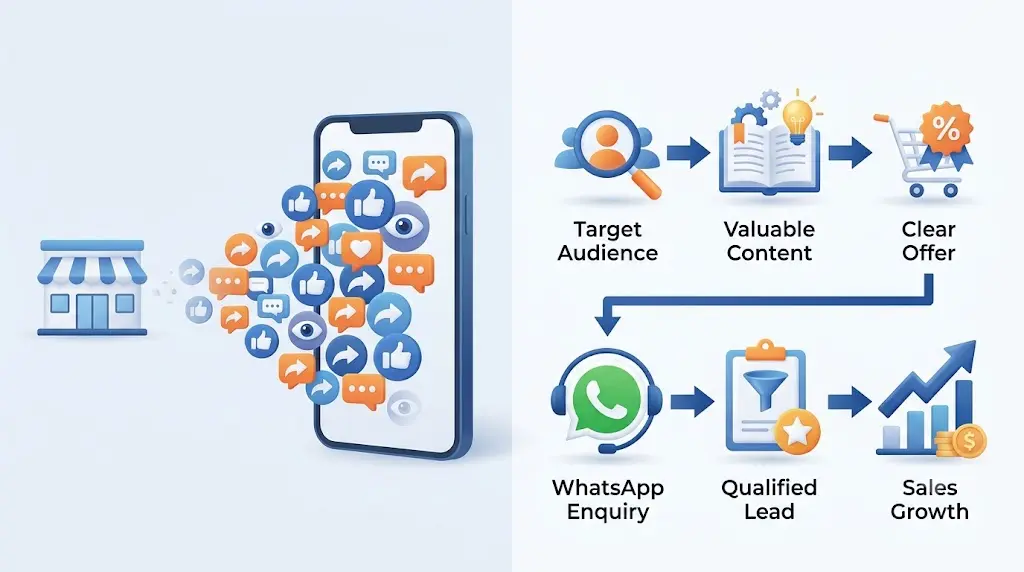
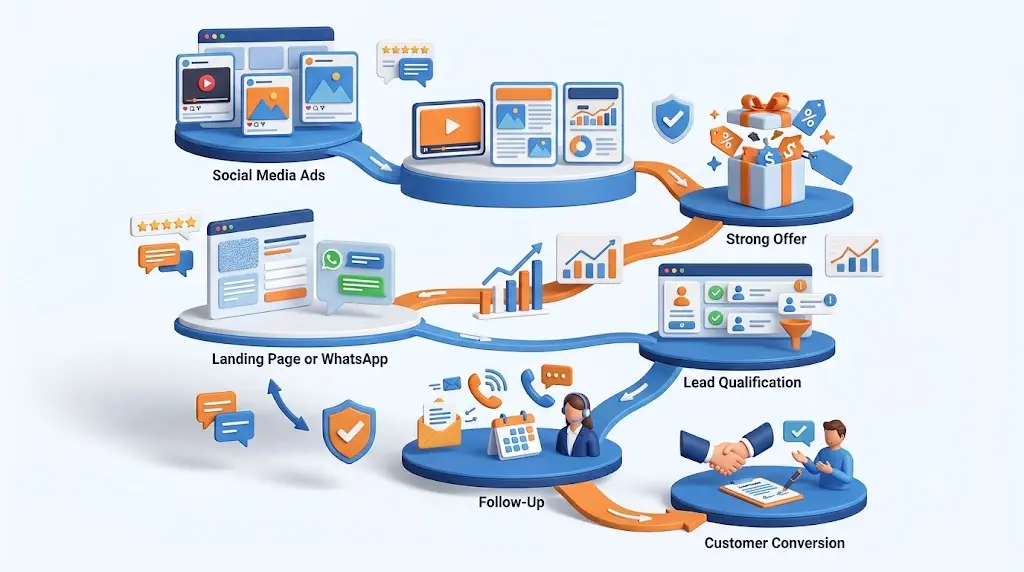
Social media lead generation works when the full journey is connected:
Customer problem → Message → Offer → Creative → Enquiry → Qualification → Follow-up → Sale
Before increasing your advertising budget, review the complete system.
Do not ask only how many leads the campaign generated.
Ask how many were relevant, contactable, qualified, and moving towards a sale.
That is the difference between social media activity and business growth.
Not getting qualified leads from social media? Addox Digital can review your content, ads, follow-up, and sales journey to identify where opportunities are being lost.
Book a consultation today and turn social media attention into measurable business growth.