Getting enquiries is only the beginning of B2B lead generation. The real challenge is turning those enquiries into qualified sales meetings with businesses that genuinely need your solution.
Many B2B companies generate leads through Google Ads, LinkedIn, websites, referrals, and digital marketing campaigns. However, not every enquiry turns into a sales opportunity.
Some prospects are ready to discuss a project. Others are comparing providers, researching solutions, or gathering pricing information.
Without a clear process, sales teams may spend valuable time following up with unsuitable leads while serious buyers receive delayed or irrelevant responses.
A B2B lead generation funnel helps solve this problem by creating a structured journey from initial enquiry to qualified sales conversation.
In this guide, we explain how the funnel works, how businesses can identify high-intent prospects, and how a better qualification and follow-up system can increase the number of useful sales meetings.
What Is a B2B Lead Generation Funnel?
A B2B lead generation funnel is a step-by-step process that moves potential business customers from their first interaction with your company toward a qualified sales discussion.
It connects marketing activities with sales actions.
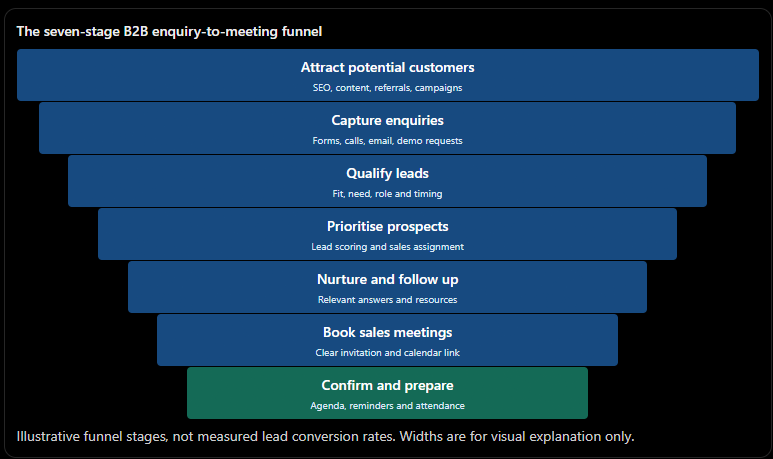
A typical B2B funnel includes seven stages:
Attract the right business audience.
Capture enquiries through relevant channels.
Qualify prospects based on their requirements.
Prioritise high-intent leads.
Nurture prospects through useful follow-ups.
Convert qualified interest into sales meetings.
Confirm meetings and track outcomes.
Each stage helps businesses understand what prospects need and what should happen next.
For example, a manufacturing company downloading a guide about production automation may only be exploring available options.
However, a company requesting a detailed quotation for an automation project may already have an active requirement.
Both enquiries can be valuable, but they should not automatically receive the same sales approach.
The main purpose of the funnel is to identify the right next step for each prospect.
Businesses that want to understand the wider customer journey can also explore how a structured sales funnel moves service enquiries toward paying customers.
Why B2B Enquiries Fail to Become Sales Meetings
One of the biggest challenges in B2B marketing is the gap between generating enquiries and converting them into actual sales conversations.
A marketing campaign may produce a large number of leads, yet the sales team may struggle to schedule meetings with suitable prospects.
This happens for several reasons.
Not Every Enquiry Has Buying Intent
Some people enquire because they are ready to purchase.
Others want to understand costs, compare suppliers, or research future options.
When every enquiry is treated as sales-ready, the team spends time contacting prospects who may not have an immediate business requirement.
Slow Responses Create Missed Opportunities
Business buyers often compare several potential providers.
If a prospect requests information and receives no timely response, the initial interest may fade.
A clear first-response process helps ensure that suitable leads are acknowledged and assigned to the right person.
Sales Teams Receive Incomplete Information
A name, phone number, and email address do not explain the prospect’s business problem.
Without knowing the requirement, purchasing role, or timeline, sales representatives may struggle to start meaningful conversations.
Follow-Ups Lack Relevance
A generic message asking whether someone is interested does little to help the buyer.
A useful follow-up should address the problem they mentioned, answer an open question, or explain the next step.
Marketing and Sales Have Different Expectations
Marketing teams may evaluate campaigns based on lead volume and cost per lead.
Sales teams are more concerned with lead quality, meetings, and potential revenue.
When these teams use different definitions of success, performance becomes difficult to assess.
Our article on why sales teams blame lead quality and how to identify the actual conversion problem explores this common disconnect.
The important lesson is that lead generation and lead conversion are connected but different processes.
A business needs both to create a consistent flow of meaningful sales opportunities.
How to Build a B2B Lead Generation Funnel That Converts
An effective funnel should guide the right prospects from initial interest to a useful business conversation without forcing every enquiry into the same sales process.
Here are the seven main stages.
Step 1: Attract the Right Business Audience
The first stage is identifying businesses that are likely to need your product or service.
This begins with an ideal customer profile.
An ideal customer profile describes the kinds of businesses your company can serve effectively.
It may include:
Industry or business category.
Company size.
Geographic location.
Common business problems.
Typical purchasing roles.
Expected project requirements.
For example, a business selling enterprise accounting software may focus on growing companies with multiple departments and complex financial reporting requirements.
Targeting a broad audience interested in accounting may generate traffic but not necessarily relevant business enquiries.
B2B companies can attract prospects through SEO, educational content, LinkedIn, search advertising, referrals, and industry events.
The right channel depends on where potential buyers research problems and compare solutions.
For businesses targeting buyers in Kerala, understanding how lead generation funnels support local business growth can provide additional context.
The objective is not simply more traffic.
It is to attract people representing businesses with problems your company is equipped to solve.
Step 2: Capture Enquiries With Useful Information
Once someone shows interest, the next step is capturing enough information to understand their requirement.
B2B enquiries may arrive through website forms, demo requests, email, telephone calls, or messaging platforms.
A useful enquiry form can request:
Name and business email.
Company name.
Job title or role.
Product or service requirement.
A short description of the business challenge.
For more complex services, a form may also ask about the expected project timeline.
However, making every field mandatory can create unnecessary friction.
For example, a consulting company may not need to ask for a detailed budget before the prospect has explained the actual requirement.
Collect enough information to start a useful conversation, not every detail needed to close a sale.
Website usability also affects whether visitors complete enquiry forms.
Businesses dealing with low form submissions can benefit from understanding how conversion rate optimisation improves the journey from website visits to enquiries.
Step 3: Qualify Leads Before Scheduling Meetings
Lead qualification helps determine whether an enquiry represents a realistic business opportunity.
One established framework is BANT, which stands for Budget, Authority, Need, and Timeline.
According to Salesforce’s explanation of the BANT framework, these factors can help sales teams structure their qualification process.
| Factor | Qualification question |
|---|---|
| Budget | Is funding available or being considered? |
| Authority | Who influences or approves the purchasing decision? |
| Need | What business problem needs to be solved? |
| Timeline | When does the business expect to evaluate or implement a solution? |
These questions help teams understand the opportunity.
However, BANT should not become a rigid reason to reject prospects.
For example, an operations manager may be responsible for evaluating a new software system even though the finance department approves the final purchase.
That manager may still be an important contact.
Qualification works best when it combines business fit, genuine need, and purchasing context.
Step 4: Prioritise High-Intent Prospects
After qualifying enquiries, businesses should prioritise prospects according to their suitability and level of interest.
A basic lead scoring system can help.
| Qualification signal | Example score |
|---|---|
| Company matches target customer profile | 25 points |
| Clear business problem | 25 points |
| Relevant buying role identified | 15 points |
| Project planned within 90 days | 20 points |
| Explicit request for a discussion or demo | 15 points |
| Maximum score | 100 points |
Illustrative scoring model, October 2026. Scores are not industry benchmarks and should be tested against actual sales outcomes.
A company might initially classify leads scoring 75 points or more as high priority.
Medium-priority leads could receive further qualification, while research-stage enquiries enter a suitable nurturing process.
These categories help the sales team decide where to focus its attention.
However, a scoring model should support human judgement rather than replace it.
A prospect with a genuine operational problem may still deserve immediate attention even when the expected budget is unknown.
Step 5: Establish a Consistent Follow-Up Process
One of the most common weaknesses in B2B lead generation is inconsistent follow-up.
A prospect submits a request, receives an acknowledgement, and then has no meaningful interaction with the business.
A clear follow-up system can prevent this.
Every qualified enquiry should have a responsible team member, a recorded status, and a next action.
For high-intent enquiries, businesses can test a first-response target of one working hour.
A possible follow-up structure is:
| Stage | Recommended action |
|---|---|
| Initial response | Acknowledge the enquiry and refer to the requirement |
| First working day | Clarify the prospect’s business need |
| Day 3 | Share a relevant guide, example, or explanation |
| Day 6 | Address an unresolved question |
| Day 10 | Offer a suitable next step |
| Day 15 | Send a respectful final check-in if appropriate |
This is an illustrative sequence. Actual timing should reflect the prospect’s engagement, communication preferences, and applicable marketing rules.
The goal is not to contact every prospect repeatedly.
It is to make sure interested businesses receive information when it is useful.
For more practical guidance, see how to build a simple follow-up system for every business enquiry.
Step 6: Nurture Leads That Are Not Ready to Buy
Some B2B buyers need time before agreeing to a sales meeting.
They may be reviewing budgets, evaluating technical requirements, comparing providers, or discussing the project internally.
Lead nurturing helps these prospects continue evaluating their options.
Relevant nurturing content can include educational articles, product comparisons, case studies, implementation guides, and answers to common questions.
For example, a company researching CRM software might first need to understand integration requirements and how its existing data could be transferred.
Sending repeated meeting requests will not answer those concerns.
Sharing a relevant implementation guide may be more useful.
Nurturing should also respect the prospect’s preferences. If a contact declines further communication or requests an unsubscribe, that decision must be honoured.
Good lead nurturing builds clarity and confidence while allowing buyers to progress at their own pace.
Step 7: Convert Qualified Leads Into Sales Meetings
Once a prospect has a clear business requirement and shows enough interest, the next step is proposing a meeting.
A good meeting invitation explains three things:
Why the discussion is relevant.
What the prospect can expect to understand.
How to schedule the conversation.
Consider this example:
“Based on your requirement to improve lead tracking across your sales team, a short discussion could help us review your current process and identify suitable next steps. Would a 20-minute call next week be useful?”
This invitation connects the meeting to an actual business problem.
It is more helpful than a generic request asking whether someone is available for a sales presentation.
Offer convenient times and share a short agenda.
Once confirmed, send a calendar invitation and ensure that the correct time zone is included.
Remember that a successful funnel should measure meetings actually held, not only meetings booked.
How to Identify Where Your B2B Funnel Is Losing Opportunities
Not every business has the same lead conversion problem.
Some companies attract unsuitable enquiries. Others generate strong leads but struggle with follow-up or meeting attendance.
The most useful improvement depends on where qualified prospects stop progressing.
| Funnel problem | Possible cause | What to improve |
|---|---|---|
| Many enquiries, few qualified leads | Broad or unsuitable targeting | Audience selection and qualification |
| Qualified leads rarely respond | Delayed or irrelevant communication | Response timing and message relevance |
| Interested prospects avoid meetings | Unclear reason for the meeting | Meeting invitation and expected outcome |
| Frequent meeting cancellations | Scheduling friction or weak confirmation | Calendar process and reminders |
| Meetings rarely become opportunities | Poor qualification or discovery | Sales conversation quality |
This approach prevents businesses from spending additional money on campaigns before understanding their existing conversion issues.
It also creates a more useful relationship between marketing and sales teams.
Marketing can identify which channels generate suitable prospects, while sales can explain why certain enquiries fail to progress.
A Practical Example: Turning 200 Enquiries Into Qualified Meetings
Consider a hypothetical B2B technology consulting company operating in Kerala.
The company receives enquiries through search advertising, organic search, LinkedIn, and referrals.
In one month, it generates 200 enquiries.
After qualification, 80 match its target customer profile and have relevant business requirements.
Of those qualified leads, 32 agree to sales meetings, and 24 attend.
The resulting funnel looks like this:
| Funnel stage | Volume | Stage conversion |
|---|---|---|
| Total enquiries | 200 | Starting volume |
| Qualified leads | 80 | 40% of enquiries |
| Meetings booked | 32 | 40% of qualified leads |
| Meetings held | 24 | 75% of booked meetings |
Hypothetical 30-day example, October 2026. These figures do not represent actual Addox client results or market benchmarks.
In this example, the enquiry-to-completed-meeting rate is 12%.
Now consider the operational questions the business should investigate.
Are unqualified leads coming from one particular channel? Do qualified leads receive responses quickly enough? Are meeting invitations clear? Are prospects missing meetings because of scheduling difficulties?
Each answer identifies a possible improvement.
For a real-world perspective on marketing work across different businesses, readers can explore Addox Digital’s published marketing case studies.
The lesson is not that every business can achieve the same conversion rate.
It is that measuring each stage helps teams identify specific problems instead of making decisions based only on enquiry volume.
What B2B Lead Generation Metrics Should Businesses Track?
A funnel becomes more useful when its performance can be measured consistently.
Instead of measuring only incoming leads, businesses should track what happens after the enquiry.
Lead Qualification Rate
This shows the percentage of enquiries that meet the business’s qualification criteria.
Formula: Qualified leads ÷ Total enquiries × 100
If 80 out of 200 enquiries qualify, the qualification rate is 40%.
Qualified Lead-to-Meeting Rate
This measures how many qualified prospects schedule meetings.
Formula: Meetings booked ÷ Qualified leads × 100
If 32 meetings are booked from 80 qualified leads, the rate is 40%.
Meeting Attendance Rate
This measures how many scheduled meetings actually take place.
Formula: Meetings held ÷ Meetings booked × 100
If 24 out of 32 booked meetings are completed, the attendance rate is 75%.
Cost per Qualified Meeting
This metric connects lead generation spending with actual sales conversations.
Formula: Relevant acquisition spend ÷ Qualified meetings held
For example, if a company spends ₹60,000 and completes 24 qualified meetings, the cost per qualified meeting is ₹2,500.
These calculations are examples, not universal performance targets.
A lower meeting cost is not necessarily better if the prospects are unsuitable.
Businesses should also measure how many completed meetings become sales opportunities and paying customers.
Common B2B Lead Generation Mistakes to Avoid
Several mistakes can weaken the connection between marketing enquiries and sales meetings.
Focusing Only on Lead Volume
A large number of enquiries can make a campaign appear successful, even when few contacts have genuine buying intent.
Businesses should evaluate both quantity and quality.
Our article explaining the difference between generating leads and generating sales covers why these outcomes should not be confused.
Sending Every Lead Directly to Sales
Research-stage prospects may not need an immediate sales conversation.
Separating them from high-intent enquiries allows the team to provide more relevant communication.
Using the Same Message for Every Prospect
Generic follow-ups fail to acknowledge the differences between industries, business requirements, and buying stages.
Personalise communication based on the information the prospect has shared.
Booking Meetings Without a Clear Purpose
A meeting should help both parties understand a specific business challenge or potential solution.
When the purpose is unclear, prospects may decline or fail to attend.
Ignoring Data Protection and Communication Preferences
Marketing automation should not mean sending unwanted messages.
Businesses need to follow the consent, privacy, and communication rules applicable to their target audiences.
For example, the UK Information Commissioner’s Office guidance on business-to-business marketing explains how privacy obligations can apply to business contacts.
Companies operating across regions should review the laws relevant to each market.
A 30-Day Plan to Improve Your B2B Lead Generation Funnel
Businesses can start improving their funnel without replacing their entire marketing system.
A practical approach is to review the existing process and address the most visible gaps.
Week 1: Audit Existing Enquiries
Review recent enquiries and identify their sources, status, response times, and outcomes.
Find out how many became qualified leads, meetings, and sales opportunities.
Week 2: Define Qualification and Ownership
Create a simple qualification framework.
Identify what makes a prospect suitable and decide who is responsible for following up with each enquiry.
Week 3: Improve Follow-Ups and Scheduling
Develop relevant response templates, define follow-up timing, and introduce a consistent meeting confirmation process.
Ensure that prospects understand the purpose of proposed discussions.
Week 4: Measure Results and Refine
Review conversion rates across the funnel.
Identify the stage with the greatest loss of suitable prospects and choose one change to test.
For example, the team might improve form questions, reduce response delays, or revise meeting invitations.
Keep tracking the results over time so that changes can be assessed using actual business data.
B2B Lead Generation Funnel Checklist
Before increasing spending on lead generation, review whether your business has the following in place:
- A clearly defined target customer profile.
- Relevant enquiry channels.
- A lead capture process that gathers useful information.
- Consistent qualification criteria.
- Assigned responsibility for every qualified enquiry.
- A realistic response-time target.
- Follow-up messages based on prospect requirements.
- Content for buyers who need more information.
- Clear meeting invitations and scheduling options.
- Tracking for booked and completed meetings.
- Regular reviews of conversion rates and lead quality.
A clear process makes it easier to identify missed opportunities and improve how marketing and sales work together.
Frequently Asked Questions
What is a B2B lead generation funnel?
A B2B lead generation funnel is a structured process that moves potential business customers from initial interest toward qualified sales conversations. It includes attracting prospects, capturing enquiries, qualifying leads, nurturing interest, and booking meetings.
How can B2B businesses turn enquiries into sales meetings?
Businesses can improve meeting conversion by identifying suitable prospects, responding promptly, providing relevant information, and making meeting invitations useful and easy to accept. Clear ownership and consistent tracking are also important.
What is the difference between a B2B enquiry and a qualified lead?
An enquiry is an initial expression of interest. A qualified lead is a prospect assessed against factors such as business need, company fit, purchasing involvement, and project timeline.
How quickly should a business respond to B2B enquiries?
High-intent enquiries should receive prompt attention during working hours. Businesses can test an internal target, such as responding within one business hour, and adjust it according to enquiry type, team capacity, and customer expectations.
What is a good B2B lead-to-meeting conversion rate?
There is no universal conversion rate across all B2B industries. Results vary according to lead source, qualification standards, product complexity, and buyer intent. Businesses should measure their own baseline and compare performance over time.
Does lead nurturing help increase B2B sales meetings?
Lead nurturing helps businesses maintain useful contact with prospects who are not ready for immediate discussions. Relevant resources and timely answers can help buyers understand their options and decide when a meeting makes sense.
Can small B2B businesses build a lead generation funnel without a CRM?
Yes. Small teams can start with a shared spreadsheet, qualification rules, assigned lead ownership, and a consistent follow-up process. A CRM becomes more useful as enquiry volume and team complexity increase.
Turn B2B Enquiries Into Meaningful Sales Opportunities
A successful B2B lead generation funnel does more than collect contact information.
It helps businesses identify suitable prospects, understand their requirements, maintain relevant communication, and create meaningful sales conversations.
The key stages are straightforward: attract the right audience, capture useful information, qualify enquiries, prioritise interested prospects, nurture relationships, and make it easy to schedule meetings.
However, the real value comes from managing these stages consistently.
For businesses struggling to convert enquiries into sales meetings, increasing the advertising budget may not be the first solution.
Improving qualification, response quality, sales ownership, and meeting scheduling can make existing lead generation efforts more effective.
For businesses that need support connecting marketing enquiries with sales activities, Addox Digital’s lead generation services provide a starting point for exploring the available options.
You can also schedule a discovery call with Addox Digital to discuss your current enquiry process and the challenges affecting sales conversations.
The goal of a strong B2B lead generation funnel is not simply to generate more leads. It is to create better sales conversations with businesses that have a genuine reason to buy.