

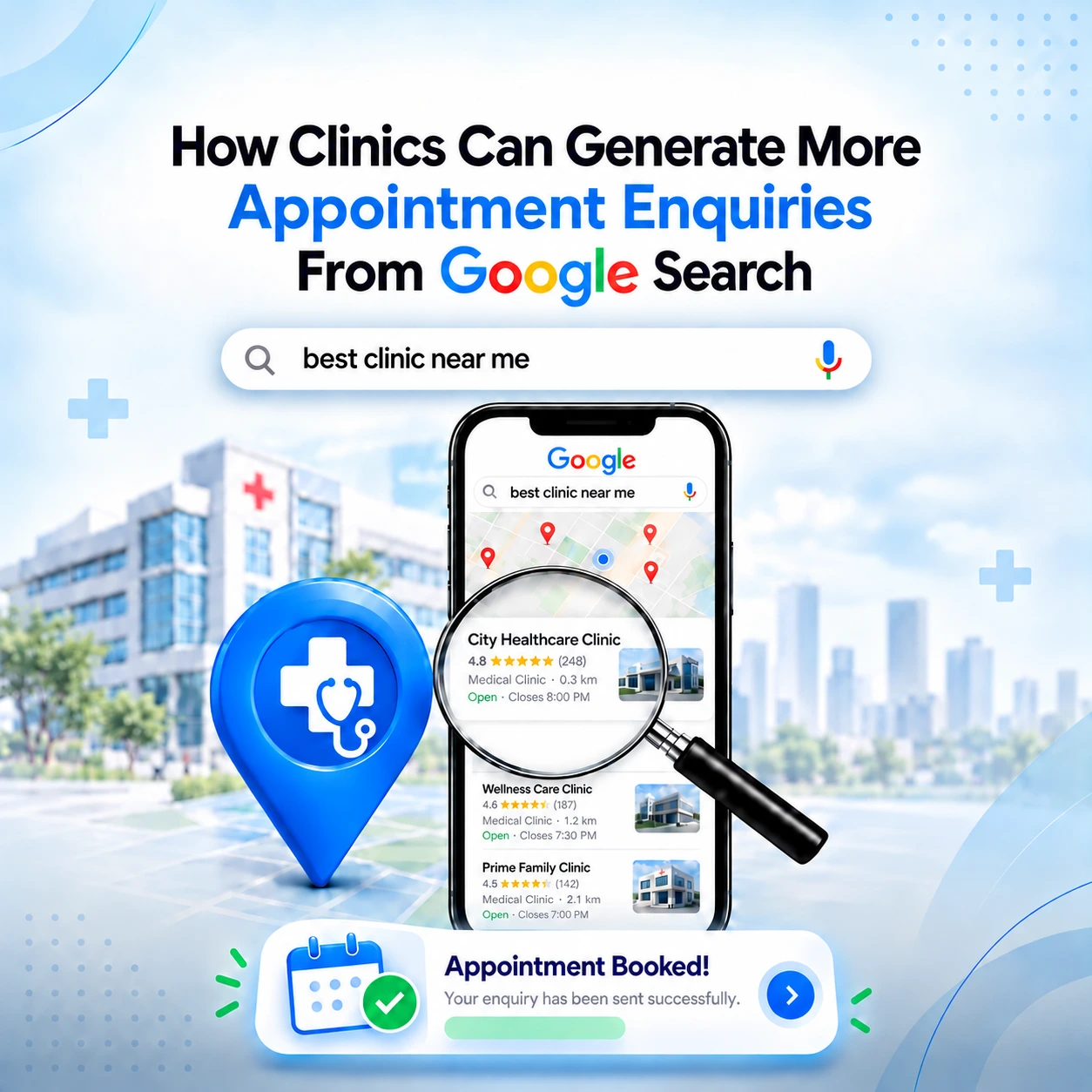
Clinic appointment enquiries from Google Search can help healthcare businesses in Kerala connect with people who are actively looking for nearby medical services.
Think about someone searching for a “dental clinic in Kochi” or “physiotherapy clinic near me.” They want practical information: where the clinic is, which services are available, when consultations take place, and how to request an appointment.
But appearing in Google results does not automatically mean receiving enquiries.
Clinics need three things to work together: Google visibility, trustworthy information, and an easy appointment process.
This guide explains how clinics can improve each of these areas and measure results without relying entirely on paid advertising.
Why Google Search Matters for Clinics in Kerala
Google Search and Maps can connect clinics with people looking for healthcare information in specific locations.
Patients and families often compare nearby healthcare facilities before deciding where to request a consultation.
For example, a person in Thrissur may search for a dermatology clinic, while someone in Malappuram may check the operating hours of a nearby dental clinic.
Google can display relevant websites, clinic locations, contact details, and other business information.
This creates two main opportunities:
- Google Search: Your website can appear when people search for relevant healthcare services or clinic information.
- Google Maps: Your clinic may appear in local results when users look for nearby facilities.
According to Google’s official local ranking guidance, local results are mainly influenced by relevance, distance, and prominence.
However, visibility is only the first step. The clinic must also provide the information people need to make an informed enquiry.
How Google Searches Become Clinic Appointment Enquiries
More search traffic does not guarantee more appointments; clinics must make every stage of the enquiry process clear.
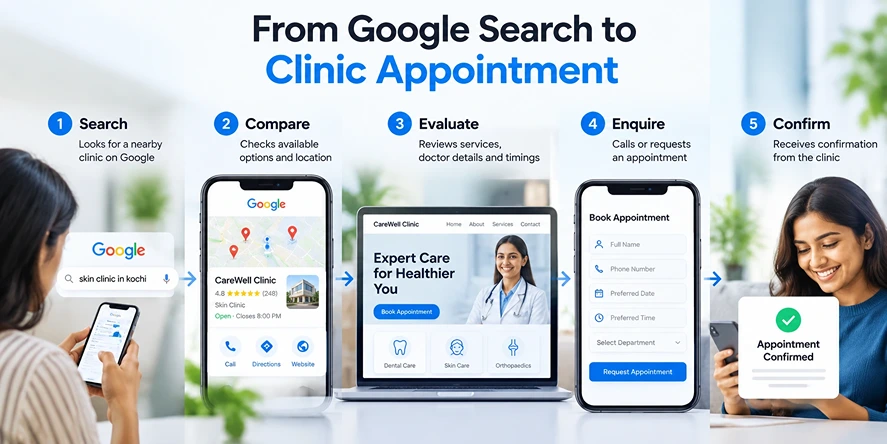
Before improving rankings, clinic owners should understand how a search can lead to an appointment.
Stage | What a person does | What the clinic should provide |
Search | Looks for a nearby clinic | Accurate local visibility |
Compare | Checks available options | Clear services and location |
Evaluate | Reviews practical information | Verified doctor details and timings |
Enquire | Calls or requests a slot | Working contact and booking options |
Confirm | Waits for an answer | Reliable reception follow-up |
A clinic could attract relevant website visitors but still miss enquiries because its phone number is incorrect or the appointment form does not work.
This is why the goal should not be more traffic alone.
The real objective is to help people move smoothly from finding the clinic to requesting suitable appointment information.
For a broader perspective, see how Kerala local businesses can generate enquiries through Google.
Optimise Your Google Business Profile for Local Visibility
A complete and accurate Google Business Profile can make your clinic easier to discover and contact.
A Google Business Profile is one of the most useful tools for managing how an eligible clinic appears on Google Search and Maps.
It can show your clinic’s location, contact details, working hours, website, and other relevant information.
What should clinic owners update?
Start with:
- Correct clinic name, address, and reception number
- Accurate working and consultation hours
- Appropriate business category
- Website and available appointment links
- Genuine facility photographs, where permitted
- Accurate information about available services
For example, if a clinic in Perinthalmanna changes its consultation timings, the information displayed on Google should be updated.
Otherwise, people may call or visit when the relevant service is unavailable.
Local SEO works best when online information matches the clinic’s actual operations.
Google also provides guidance on eligible appointment links, although the availability of booking features varies by business and region.
Target Relevant Local Keywords and Create Useful Pages
Location-specific keywords help search engines match clinic information with relevant local searches.
Search engine optimisation (SEO) means improving a website’s visibility in relevant search results.
For Kerala clinics, useful keywords often include both a medical service and a location.
Examples include:
- Dental clinic in Kochi
- Physiotherapy clinic in Perinthalmanna
- Skin clinic in Thrissur
- Paediatric clinic in Kozhikode
- Orthopaedic clinic in Malappuram
These are examples of search phrases, not verified keyword-volume figures.
Clinics should use relevant wording naturally in their website headings, page titles, and service descriptions.
Create pages that answer real questions
A dermatology clinic page, for example, could clearly explain available consultations, clinic location, appointment procedures, and opening hours.
A patient information blog could answer general questions within the clinic’s area of clinical expertise, with professional review.
According to Google’s people-first content guidance, content should primarily help readers rather than exist just to attract search traffic.
Avoid publishing multiple identical pages with only the city name changed. A location page should provide unique information about a genuine clinic branch.
Build a Clinic Website That Makes Enquiries Easier
Clear service information and simple contact options can remove barriers between website visits and appointment requests.
A clinic’s website should be more than an online brochure.
It should help people quickly understand what the clinic offers and how to contact reception.
Important information includes:
- Actual services and facilities
- Clinic address and directions
- Verified practitioner information
- Consultation availability
- Accessible contact details
- Clear appointment instructions
Keep the mobile experience simple
Someone searching on a phone should not have to zoom in, open several pages, or complete a lengthy form just to contact reception.
A clearly labelled call button and a short, secure appointment request form can make the process more convenient.
If WhatsApp is used for administrative enquiries, the clinic should apply suitable privacy safeguards and avoid collecting unnecessary medical information.
For a wider look at the gap between traffic and enquiries, read why Kochi businesses get traffic but struggle to receive enquiries.
Make Appointment Booking and Follow-Up Reliable
A dependable reception process matters as much as having an accessible appointment button.
A website enquiry is not necessarily a confirmed appointment.
Consider a person who submits an appointment request but receives no response from the clinic. Even with good Google visibility, the process has failed.
Clinic owners should check whether:
- Phone calls reach the correct reception team.
- Online requests are delivered successfully.
- Staff can confirm available consultation slots.
- Patients receive clear booking instructions.
- Unanswered enquiries are identified and handled.
A request form should clearly state whether it has submitted an enquiry or confirmed an appointment.
For clinics with several doctors or departments, keeping consultation schedules updated is especially important.
Improving reception handling may offer more immediate value than publishing another SEO article.
Build Trust With Ethical, Accurate Healthcare Information
Verified healthcare information supports informed decisions; misleading claims and manipulated reviews create legal and ethical risks.
Healthcare marketing is different from ordinary business promotion.
People depend on accurate medical information when making important decisions.
Clinic websites should therefore focus on factual details, recognised qualifications, facilities, services, accessibility, and appointment procedures.
What about Google reviews?
Reviews may appear independently on Google and influence how people assess a clinic. However, clinics must be careful not to manufacture, manipulate, or use them in prohibited promotional campaigns.
Google’s review content policy prohibits fake and incentivised reviews.
The National Medical Commission also issued ethical advertising and public communication guidelines on 6 October 2026.
These restrict misleading medical claims, prohibited testimonials, unsupported superiority statements, and promotional practices that encourage unnecessary medical services.
For clinics, patient trust should come from reliable information and professional care, not exaggerated advertising.
Measure Appointment Enquiries, Not Just Google Rankings
Search visibility should be measured alongside actual enquiries, reception responses, and confirmed appointments.
Many clinic owners focus on whether their website appears on Google’s first page.
But rankings alone cannot show whether people are successfully contacting the clinic.
A more useful approach is to track search interactions and appointment outcomes.
Metric | Measurement unit | What it tells you |
Google Search clicks | Clicks/month | Search visits to the website |
Business Profile call clicks | Clicks/month | Taps on the profile’s call button |
Appointment requests | Requests/month | Enquiries received by the clinic |
Confirmed bookings | Appointments/month | Consultations scheduled |
Missed enquiry calls | Calls/month | Potential reception handling gaps |
Clinic owners can use Google Search Console, Google Business Profile performance reports, and privacy-conscious reception records to evaluate results.
For example, if website clicks increase but confirmed appointments stay unchanged, examine the booking process before deciding to increase SEO spending.
Tracking should use aggregated administrative data wherever possible and avoid unnecessary patient health information.
Kerala Clinic Example: Fixing the Appointment Journey
Correcting appointment barriers can be a better first step than investing immediately in additional website traffic.
Consider an illustrative physiotherapy clinic in Perinthalmanna.
The clinic appears on Google and receives website visits, but few appointment enquiries.
A review reveals three problems:
- Its Google profile displays an outdated phone number.
- The appointment button is difficult to find on mobile.
- Reception does not consistently record missed enquiries.
The clinic could first correct its contact information, make the appointment option more visible, and introduce a simple enquiry log.
After these changes, it could compare incoming enquiries and confirmed appointments over a consistent reporting period.
This example is hypothetical, not a reported client result.
The practical lesson: Before spending more on search traffic, check whether your existing visitors can reach the clinic easily.
A 30-Day Google Search Improvement Plan for Clinics
A phased plan helps clinic owners improve visibility, appointment access, and measurement without changing everything at once.
Clinic owners can use this simple framework to prioritise improvements.
Period | Priority | Suggested effort | Expected value |
Days 1–7 | Audit Google profile and contact details | 2–4 hours | Fix inaccurate information |
Days 8–14 | Improve website and mobile booking access | 4–8 hours | Reduce enquiry barriers |
Days 15–21 | Update relevant service and location pages | 4–8 hours | Improve information quality |
Days 22–30 | Set up and review enquiry reporting | 3–5 hours | Identify missed opportunities |
Checklist 1: Google visibility
- Verify your Google Business Profile.
- Confirm name, address, and phone number.
- Update working hours and service information.
- Check relevant keywords and existing clinic pages.
Proof to keep: Dated profile screenshots and website audit notes.
Checklist 2: Appointment enquiries
- Test website call and booking buttons.
- Check mobile usability.
- Ensure appointment requests reach reception.
- Record enquiries and confirmed bookings.
- Review missed calls and response procedures.
Proof to keep: Monthly enquiry totals, booking records, and a dated improvement log without unnecessary patient details.
Common Mistakes Clinics Should Avoid
Poor local information, weak contact processes, and misleading promotional content can reduce the usefulness of a clinic’s online presence.
Some common problems include:
Focusing only on Google rankings: Website visits are useful, but clinic owners must also know whether enquiries become appointments.
Ignoring mobile visitors: Small text, slow pages, and difficult appointment forms make the experience inconvenient.
Using outdated consultation details: Incorrect opening hours and schedules can cause confusion.
Creating repetitive location pages: Content should reflect genuine branches and actual service availability.
Using exaggerated healthcare claims: Unsupported success rates, guarantees, and prohibited promotional testimonials can undermine patient trust and violate medical advertising rules.
Correcting these issues should form part of routine clinic website maintenance.
Frequently Asked Questions
Clinics can improve their Google Business Profiles, create relevant service pages, and make contact options easier to use. Tracking genuine enquiries and improving reception follow-up are equally important.
Yes. Eligible clinics can use it to display essential information on Google Search and Maps. Accurate location details, operating hours, and contact information can help people find the clinic.
There is no fixed timeline. Correcting contact details can improve accessibility quickly, while organic search visibility often requires longer-term work and ongoing measurement.
SEO supports organic visibility, while Google Ads involves paid placement. Clinics should assess their needs and have any advertising activity reviewed against applicable healthcare marketing regulations.
Track appointment enquiries, received calls, missed enquiries, and confirmed bookings. These provide a clearer view of how effectively the clinic handles search-driven interest.
Clinics must follow Google policies and relevant medical advertising restrictions. Fake reviews, incentivised ratings, and prohibited promotional patient testimonials should not be used.
Generating more clinic appointment enquiries from Google Search is not just about appearing higher in search results.
For clinics in Kerala, meaningful improvements often begin with accurate Google listings, relevant website information, convenient appointment options, and dependable reception handling.
A clinic that is easy to find but difficult to contact still has an important problem to solve.
Focus on helping people find reliable healthcare information, understand their options, and request appointments without unnecessary difficulty.
That creates a more useful online presence while keeping patient trust and ethical communication at the centre.
Turn Google Searches Into More Clinic Enquiries
Improve your clinic's online visibility and make it easier for patients to contact you with Addox Digital.
Talk to Addox Digital →
