

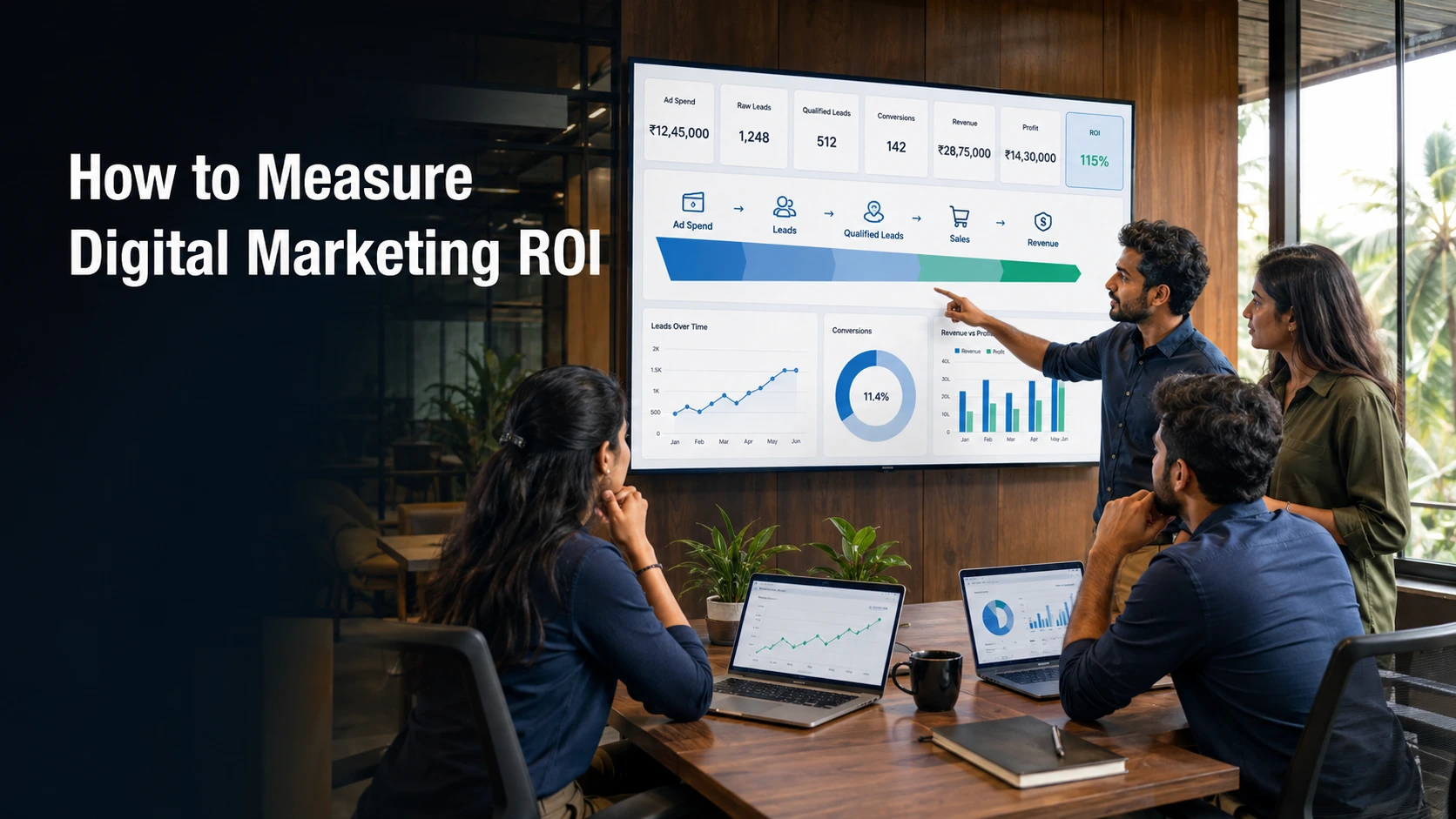
How to Measure Digital Marketing ROI: Metrics That Actually Matter
Digital marketing reports are filled with numbers—reach, impressions, clicks, website traffic, enquiries and cost per lead.
But business owners need an answer to a more important question:
Did our marketing investment generate qualified leads, customers and profitable revenue?
A campaign can generate hundreds of cheap leads and still deliver poor returns. Another campaign may have a higher CPL but attract serious buyers who convert faster and produce more revenue.
A lead is not the same as a customer. Understanding the difference between leads and sales is the first step towards measuring marketing performance correctly.
At Addox Digital, we evaluate the full journey:
Ad Spend → Lead → Qualified Lead → Follow-Up → Sale → Revenue → Profit
This guide explains how to measure digital marketing ROI using the metrics that actually matter.
What Is Digital Marketing ROI?
Digital marketing ROI measures the financial return generated from the total amount invested in marketing.
The basic formula is:
Digital Marketing ROI = (Revenue Generated − Marketing Cost) ÷ Marketing Cost × 100
Suppose a business invests ₹1,00,000 in marketing and generates ₹3,00,000 in attributable revenue:
ROI = (₹3,00,000 − ₹1,00,000) ÷ ₹1,00,000 × 100 = 200%
However, calculating ROI only with the amount shown inside Meta Ads or Google Ads can create an inaccurate result.
The total marketing investment may include:
- Advertising spend
- Creative production
- Agency or internal team costs
- Landing-page development
- CRM and automation tools
- Call tracking and sales-support costs
Businesses should also distinguish between revenue-based ROI and profit-based ROI.
If ₹3,00,000 in revenue produces only ₹1,50,000 in gross profit, the business should calculate the final return using gross profit—not just the total sales value.
Metrics That Actually Matter
Different metrics explain different stages of marketing performance. No single metric can provide the complete answer.
1. Cost per Lead
Cost per lead measures how much was spent to generate one enquiry.
CPL = Campaign Spend ÷ Total Leads
If a campaign spends ₹20,000 and generates 200 leads, the CPL is ₹100.
CPL helps compare campaigns, creatives, audiences, locations and advertising platforms. But it does not show whether the enquiries were relevant or whether they became customers.
A ₹50 lead that never answers the phone is not necessarily better than a ₹300 lead that converts into a ₹30,000 sale.
That is why CPL should never be treated as the final measure of campaign success.
2. Cost per Qualified Lead
Raw leads may include:
- Invalid numbers
- Duplicate submissions
- People outside the target location
- Job seekers
- People without the necessary budget
- Accidental form submissions
- Enquiries without genuine purchase intent
A qualified lead matches the business’s agreed criteria, including requirement, location, budget, eligibility, timeline and buying intent.
Cost per Qualified Lead = Campaign Spend ÷ Qualified Leads
Consider this example:
| Campaign | Spend | Raw Leads | Raw CPL | Qualified Leads | Qualified CPL |
|---|---|---|---|---|---|
| Campaign A | ₹20,000 | 200 | ₹100 | 20 | ₹1,000 |
| Campaign B | ₹20,000 | 100 | ₹200 | 50 | ₹400 |
Campaign A has the cheaper raw CPL. However, Campaign B produces qualified opportunities at a much lower cost.
Therefore, Campaign B is commercially stronger.
Businesses receiving too many irrelevant enquiries should examine their targeting, creative message and qualification process. These Meta Lead Ads best practices explain how businesses can improve lead quality instead of focusing only on volume.
3. Lead Qualification Rate
Lead qualification rate shows what percentage of total enquiries are relevant to the business.
Lead Qualification Rate = Qualified Leads ÷ Total Leads × 100
If a campaign generates 300 leads and 90 are qualified, the qualification rate is 30%.
A weak qualification rate may indicate:
- Unclear advertising messages
- Broad targeting
- Wrong location targeting
- Missing price or eligibility information
- Poor lead-form questions
- A mismatch between the offer and audience
It may also indicate incomplete CRM updates. Every lead should receive a clear status, such as New Enquiry, Contacted, Follow-Up, Qualified, Appointment, Negative, Converted or Lost.
Without these CRM stages, it becomes difficult to identify which campaigns and creatives generate valuable opportunities.
4. Lead-to-Sale Conversion Rate
Lead-to-sale conversion rate measures how many enquiries become paying customers.
Lead-to-Sale Conversion Rate = Customers ÷ Total Leads × 100
Businesses should calculate both:
- Raw lead-to-sale conversion rate
- Qualified lead-to-sale conversion rate
Suppose a campaign produces 200 raw leads, 60 qualified leads and 12 customers.
- Raw lead-to-sale conversion rate: 6%
- Qualified lead-to-sale conversion rate: 20%
If qualified leads are strong but conversions are weak, the problem may be sales execution rather than advertising.
Common reasons include:
- Delayed response
- Weak sales communication
- Inconsistent follow-up
- Premature price sharing
- Poor objection handling
- Missed appointments
- Lack of trust or proof
A structured sales funnel strategy for service businesses helps move enquiries through qualification, follow-up, appointments and conversion.
5. Customer Acquisition Cost
Customer acquisition cost reveals how much the business spends to acquire one paying customer.
CAC = Total Sales and Marketing Cost ÷ New Customers
If the total sales and marketing cost is ₹80,000 and the business acquires 20 customers:
CAC = ₹80,000 ÷ 20 = ₹4,000
CAC should be compared with the gross profit generated from each customer.
If acquiring a customer costs ₹4,000 but that customer generates only ₹3,000 in gross profit, the campaign is not sustainable unless repeat purchases or renewals increase customer value.
6. Return on Ad Spend
ROAS measures the revenue directly attributed to advertising spend.
ROAS = Revenue Attributed to Ads ÷ Ad Spend
If ₹50,000 in advertising generates ₹2,00,000 in revenue, the ROAS is 4x.
However, ROAS is not the same as ROI.
ROAS normally excludes creative production, agency fees, staff salaries, CRM expenses, landing-page costs and fulfilment costs.
Use ROAS to evaluate advertising efficiency and ROI to evaluate the overall business return.
Addox Insight: CPL Benchmarks from Kerala Campaigns
Based on campaigns managed by Addox Digital, raw CPL for Kerala tuition and EdTech campaigns commonly falls between ₹20 and ₹100.
After removing invalid, irrelevant and low-intent enquiries, the qualified CPL frequently falls between ₹30 and ₹80.
Strong campaigns can occasionally perform below this range. Addox has recorded results such as:
- Approximately ₹24 qualified CPL for Learnfidence
- Qualified leads as low as ₹6 CPL for Mentor during a previous-year campaign
- Approximately ₹13 CPL quality leads for KMT Silks through Meta Ads
These campaigns also produced meaningful business results. However, these numbers should be treated as strong campaign outcomes—not guaranteed benchmarks for every business.
CPL changes according to:
- Industry competition
- Location and audience size
- Offer strength
- Creative quality
- Seasonality
- Lead-form questions
- Brand awareness
- Sales response time
The cheapest lead is not always the most valuable lead. A realistic CPL benchmark should be based on the quality and revenue potential of each enquiry.
Meta Ads vs Google Ads: Which Produces Better ROI?
Meta Ads and Google Ads reach customers at different stages of intent.
Google Ads usually captures people who are actively searching for a service. These enquiries may have stronger immediate intent, but keyword competition can make the CPL significantly higher.
From Addox’s campaign experience, Google Ads CPL can sometimes reach ₹1,000 or more, depending on the industry, keywords, location and demand.
Meta Ads usually generates higher lead volume at a lower CPL. Lead intent can vary, but Meta can still generate quality enquiries when the creative, offer, qualification and follow-up systems are properly aligned.
| Platform | Lead Volume | CPL Pattern | Typical Behaviour |
|---|---|---|---|
| Meta Ads | Usually higher | Usually lower | Users discover the offer while browsing |
| Google Ads | Usually lower | Usually higher | Users are actively searching for a solution |
The correct comparison should include:
- Qualified CPL
- Appointment rate
- Conversion rate
- Customer acquisition cost
- Revenue and gross profit
- Final ROI
A ₹1,000 Google lead can be valuable if it has strong buying intent. A ₹50 Meta lead can also be profitable when the business has proper qualification and follow-up.
Read our detailed Google Ads vs Meta Ads comparison for Kerala businesses for a platform-specific breakdown.
Sales Response Time Directly Affects ROI
Businesses frequently blame advertising when the actual leakage occurs after the lead arrives.
Track these sales-execution metrics:
- First-response time
- Percentage of leads contacted
- Number of follow-up attempts
- Appointment-booking rate
- Appointment show-up rate
- Percentage of leads with a final CRM status
For high-intent enquiries, the customer should receive an immediate WhatsApp acknowledgement followed by a timely call.
If the first call happens the following day, the customer may have already contacted a competitor.
Businesses losing enquiries after the first call need a simple follow-up system for every enquiry rather than immediately increasing their advertising budget.
Practical Digital Marketing ROI Example
Imagine a Kerala service business runs a one-month campaign:
- Ad spend: ₹60,000
- Other marketing costs: ₹20,000
- Total marketing investment: ₹80,000
- Raw leads: 300
- Qualified leads: 90
- Customers acquired: 18
- Revenue generated: ₹3,60,000
- Gross profit: ₹1,80,000
The results are:
| Metric | Result |
|---|---|
| Raw CPL | ₹200 |
| Qualified CPL | ₹667 |
| Customer acquisition cost | ₹4,444 |
| ROAS | 6x |
| Revenue-based ROI | 350% |
| Gross-profit-based ROI | 125% |
Each metric answers a different question:
- CPL: How efficiently did we generate enquiries?
- Qualified CPL: How much did a relevant opportunity cost?
- CAC: How much did it cost to acquire a customer?
- ROAS: How efficiently did ad spend generate revenue?
- Profit-based ROI: Was the complete marketing investment profitable?
Scale, Optimise, Fix or Pause?
At Addox Digital, campaign decisions are not based on CPL alone.
Scale when:
- Qualified CPL is sustainable
- Sales conversion is healthy
- CAC is profitable
- Lead quality remains consistent
- The sales team can handle more enquiries
Optimise when:
- Raw CPL is good but qualification is weak
- Some creatives generate better-quality leads
- A location produces too many irrelevant enquiries
- Lead volume is strong but conversions are falling
Fix the sales process when:
- Qualified leads are contacted late
- Follow-ups remain incomplete
- CRM stages are missing
- Appointment show-up rates are weak
- Salespeople have significantly different conversion rates
Pause when:
- Qualified CPL remains unsustainable
- Invalid leads remain high after optimisation
- CAC is higher than the available customer profit
- The offer shows weak market demand
- Tracking is too incomplete for reliable decisions
Before increasing campaign spend, understand why more ad budget does not always bring better sales.
How Addox Approaches ROI-Focused Marketing
At Addox Digital, performance is not reduced to a screenshot from Ads Manager.
We connect:
Campaign Data → Lead Quality → CRM Status → Sales Feedback → Conversion → Revenue
This helps us determine whether the real issue is the audience, creative, offer, landing page, qualification system, response speed or sales follow-up.
As an ROI-focused marketing agency in Kerala, our goal is not simply to deliver more leads. We build measurable marketing and sales-support systems focused on profitable growth.
Explore our digital marketing case studies to see how campaign strategy, lead generation and sales support work together.
Frequently Asked Questions
What is a good digital marketing ROI?
A good ROI depends on profit margin, sales cycle, average order value and customer lifetime value. Businesses should set their target based on gross profit and sustainable CAC.
Is ROAS the same as ROI?
No. ROAS compares revenue with advertising spend. ROI evaluates the financial return from the complete marketing investment.
Why can a low-CPL campaign have poor ROI?
Low-cost enquiries may be irrelevant, invalid or difficult to contact. If few become customers, CAC increases and ROI falls.
Should businesses track raw CPL or qualified CPL?
Both should be tracked. Raw CPL measures advertising efficiency, while qualified CPL measures the cost of generating relevant sales opportunities.
Can Meta Ads generate quality leads?
Yes. Meta Ads can generate quality leads when the creative, offer, targeting, qualification questions and sales follow-up are properly aligned.
Final Takeaway
Digital marketing ROI cannot be measured using Ads Manager alone.
Businesses must connect:
Campaign → Lead → Qualification → Follow-Up → Sale → Revenue → Profit
Do not choose a campaign only because it has the lowest CPL. Measure qualified lead cost, sales conversion, CAC, ROAS and profit-based ROI.
If your report shows how many leads were generated but cannot explain how many became customers, the next requirement may not be more advertising.
It may be better tracking, stronger CRM discipline and more consistent sales follow-up.
Ready to Measure What Your Marketing Is Actually Producing?
Stop judging campaigns only by clicks, leads and CPL. Addox Digital connects advertising, lead quality, CRM follow-up, sales conversions and revenue to reveal your real marketing ROI.
Book Your Discovery Call →
