Most B2C startups think sales problems mean poor ads or weak sales teams.
In reality, brand mistakes silently block buying decisions long before sales begins—especially in competitive, price-sensitive markets like Kerala.
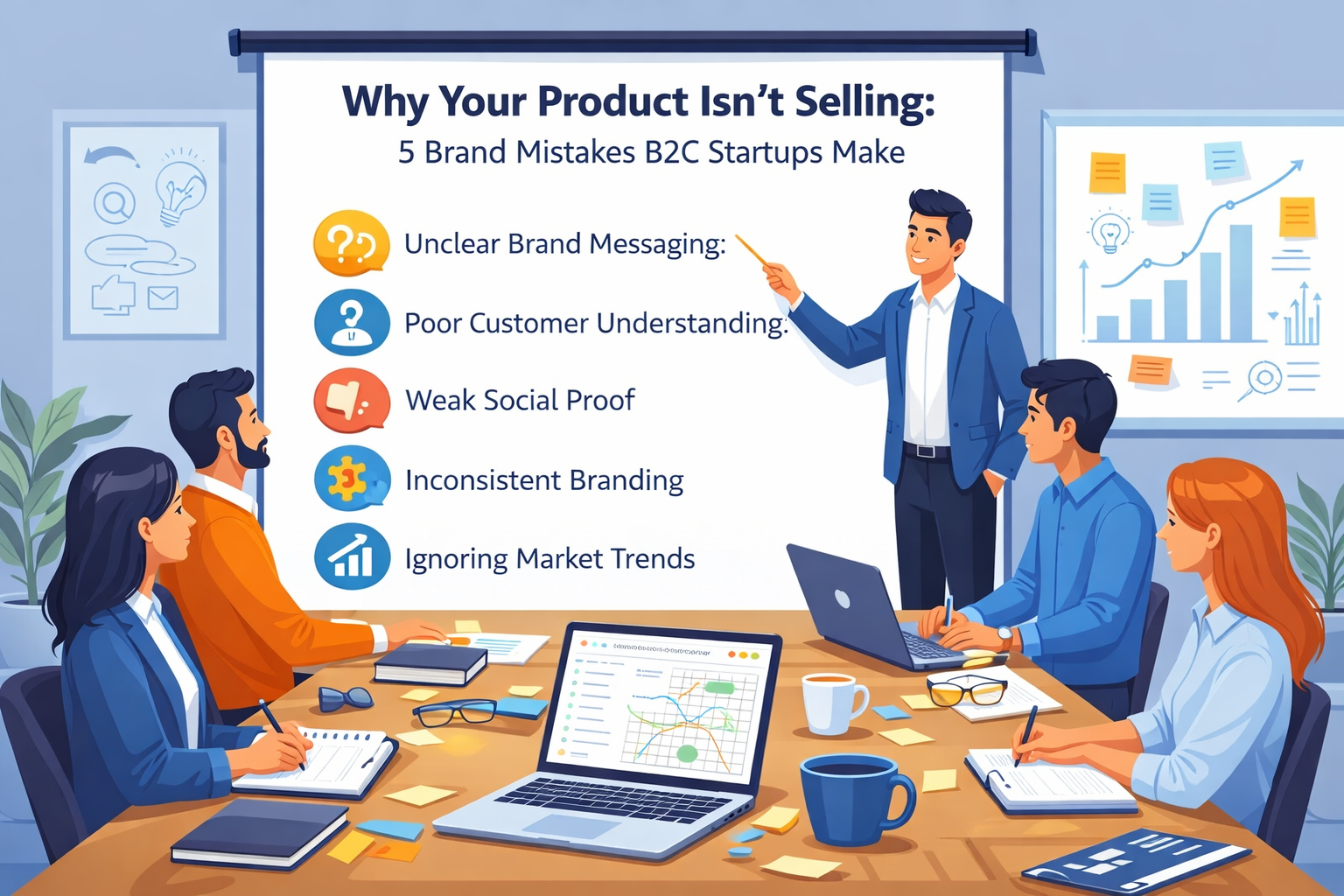
This article explains why your product isn’t selling, the 5 brand mistakes B2C startups make, and how to fix them using sales-focused marketing and sales support.
Introduction
If your product isn’t selling, the issue is rarely the product itself.
For B2C startups, brand gaps often stop trust, recall, and action—before sales teams or ads get a chance.
In Kerala’s crowded startup market, branding mistakes quietly kill conversions, even when demand exists.
In B2C markets, weak branding reduces sales even when pricing and ads are competitive
Kerala consumers compare fast, ask peers, and hesitate on unfamiliar brands. During my own startup projects in Kochi, I noticed products with weaker brand clarity lost sales despite better features.
Sales-focused marketing only works when branding supports trust and clarity.
1: You’re Selling Features, Not a Clear Outcome
Most startups describe what the product is instead of what it does for the customer.
What it looks like:
“Made with premium materials”
“AI powered”
“Fast, lightweight, durable”
“100% natural”
All fine—but not persuasive.
Why it kills sales:
People don’t buy features. They buy relief, results, status, confidence, or convenience.
Fix it:
Frame your messaging like:
“From ___ to ___”
“Get ___ without ___”
“The easiest way to ___”
Example:
Instead of “Organic skincare with Vitamin C”
Say: “Brighter skin in 14 days—without harsh chemicals.”
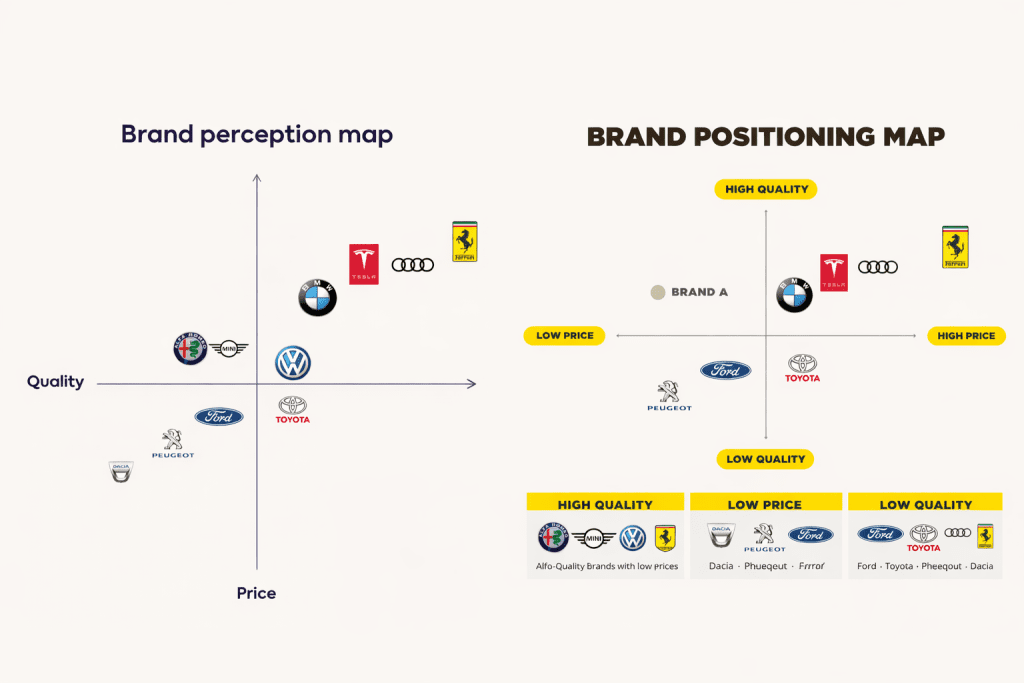
2: Your Brand Positioning Is “For Everyone”
If your product is “for everyone,” it feels like it’s for no one.
What it looks like:
Broad targeting (“men and women 18–55”)
Generic branding (“best quality at best price”)
Ads that don’t speak to a specific person
Why it kills sales:
B2C is emotional. People buy when they feel:
“This is exactly for me.”
Fix it:
Choose a clear first customer segment:
Who gets the fastest result?
Who has the most painful problem?
Who is already looking for a solution?
Then build messaging for that person.
Tip: A startup doesn’t scale by being broad.
It scales by being specific first, then expanding.
3:Your Visual Brand Looks Like “Just Another Product”
In B2C, your brand is judged in 2 seconds.
If your design looks low-trust or generic, customers assume the product is too.
What it looks like:
Inconsistent colors/fonts
No clear brand style
Packaging/creatives look like marketplace sellers
Instagram feed feels random
Why it kills sales:
Your brand is a shortcut to trust.
If it looks “cheap,” people expect:
low quality
bad service
risky purchase
Fix it:
Create a simple visual system:
2 main colors + 1 accent
2 fonts max
Same tone of imagery (lighting, style, background)
Consistent templates for posts & ads
You don’t need luxury design. You need clean + consistent.
4: You Don’t Have a Real Reason to Believe
Even if people like your product, they still think:
“How do I know this works?”
What it looks like:
No testimonials
No demos
No proof
No clear differentiation
Claims without evidence
Why it kills sales:
Customers want to avoid regret.
So they wait… compare… and don’t buy.
Fix it:
Add proof in layers:
Layer 1: Social Proof
Reviews, UGC, customer videos
Before/after
Influencer reactions
Layer 2: Product Proof
How it’s made
Real-life usage
Results timeline
Guarantee/warranty
Layer 3: Authority Proof
Certifications, media mentions
Founder story + expertise
Community numbers
Even 5 honest customer reviews can lift conversions more than a bigger ad budget.
5: Your Brand Isn’t Built for Repeat Buying
Many B2C startups focus only on the first sale.
But the real profit comes from:
repeat purchases
referrals
retention
brand loyalty
What it looks like:
No post-purchase journey
No retention offers
No brand community
No follow-up communication
Why it kills sales:
If people don’t come back, you’re stuck paying for new customers forever.
That becomes expensive—and growth stops.
Fix it:
Build a simple retention engine:
WhatsApp / Email follow-up sequence
“How to use it” content
Loyalty / referral reward
Re-order reminder at the right time
Community-style content (customers featured)
A brand that retains customers can outspend competitors in ads—and still win.
Common Mistakes & Red Flags
Rebranding without fixing messaging
Running ads before clarifying positioning
Copying competitor visuals
Ignoring local buyer behavior
Assuming sales teams can “fix” weak branding
Case Study / Field Note
Sales improved after messaging clarity, not budget increase.
In a Kerala-based D2C pilot project, we adjusted:
Homepage headline
Proof section
Visual consistency
Result:
Lead quality improved within 30 days—without increasing ad spend.
Actionable Checklist & Framework
Checklist 1: Brand Clarity Audit
Do this now:
Step 1: Write your product promise in 12 words
Step 2: Ask 5 customers to repeat it
Proof you keep: Screenshot + date
Checklist 2: Sales-Support Branding
Do this now:
Step 1: Align sales script with website copy
Step 2: Add proof to every sales touchpoint
Proof you keep: Call recording + conversion rate
FAQs
Why is my product not selling despite ads?
Because branding fails to build trust before the click turns into intent.
Is branding more important than sales?
No. Branding supports sales; it does not replace it.
Do early startups need branding?
Yes. Early branding prevents expensive repositioning later.
Does local branding matter in Kerala?
Yes. Cultural tone and proof strongly affect buying behavior.
Can sales-focused marketing fix this?
Yes—when brand, messaging, and sales support align.