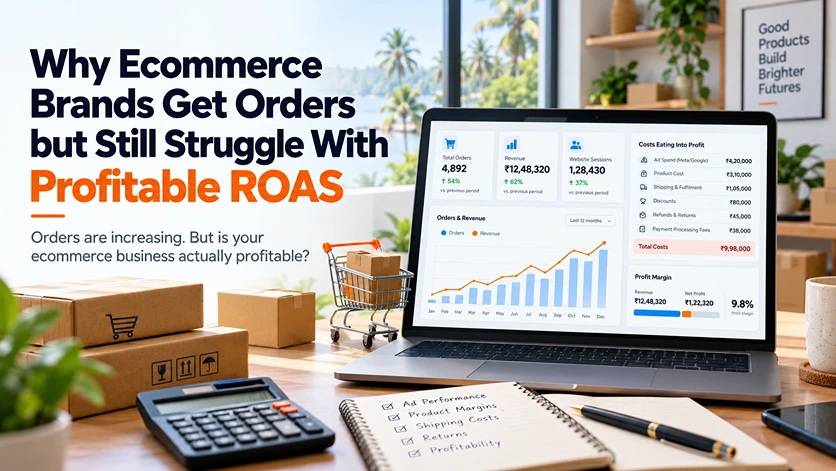
Profitable ROAS is one of the biggest challenges for growing ecommerce brands. Orders are coming in, Meta Ads and Google Ads are generating sales, and advertising dashboards show promising results. Yet when business owners review their monthly expenses, the actual profit is often disappointing.
Imagine running an ecommerce clothing brand in Kerala. Your advertising campaign generates ₹2 lakh in orders, customers are regularly purchasing products, and your ROAS looks healthy.
But after paying for inventory, advertising, packaging, shipping, discounts, and returned products, very little profit remains.
This creates an important question: If ecommerce advertising is generating orders, why is the business still struggling to make money?
The answer often lies beyond the advertisements themselves.
Ecommerce profitability depends on what happens before, during, and after each purchase. A campaign can generate impressive revenue while the business loses money fulfilling those orders.
Understanding this difference is essential for any ecommerce brand planning to grow sustainably.
Why More Ecommerce Orders Don't Always Mean More Profit
Order growth is valuable only when completed purchases generate enough revenue to cover acquisition and fulfilment costs.
Many ecommerce brands measure growth through daily orders, website sales, and advertising results.
While these numbers matter, they do not provide a complete picture of business performance.
Consider two online stores.
The first receives 300 orders every month but operates with high advertising expenses, frequent discounts, and costly returns.
The second receives only 150 orders but sells products with healthier margins and fewer delivery failures.
Despite receiving fewer orders, the second business may generate more profit.
The difference is how much money remains from each completed transaction.
Every ecommerce order moves through several stages:
- A customer places an order.
- The business confirms and processes it.
- The product is packed and shipped.
- The customer receives the product and completes payment, where applicable.
- The business retains the sale without a full refund.
An order recorded at checkout does not guarantee that the business will receive and retain the expected revenue.
For this reason, ecommerce brands should measure successful completed sales rather than depending entirely on order volume.
What Is Profitable ROAS in Ecommerce?
Profitable ROAS depends on the revenue retained after the costs of selling and fulfilling orders.
Return on Ad Spend (ROAS) measures how much revenue an advertising campaign is credited with generating for every rupee spent.
The basic calculation is:
ROAS = Revenue attributed to ads ÷ Advertising spend
For example, if an ecommerce brand spends ₹20,000 on advertisements and generates ₹80,000 in attributed purchases, its ROAS is 4x.
This means the campaign reports ₹4 in revenue for every ₹1 spent.
However, that ₹80,000 is not the business’s profit.
The brand still needs to pay for product sourcing, packaging, courier services, payment processing, and other expenses.
That is why a 4x ROAS can be profitable for one ecommerce brand and unprofitable for another.
A business selling high-margin products may earn a healthy return from a 3x campaign. Meanwhile, a business with expensive inventory and high fulfilment costs may struggle even at 5x.
The important distinction is between advertising efficiency and actual financial performance.
A profitable advertising strategy should consider both.
The Hidden Costs That Reduce Ecommerce Profitability
Small losses across product margins, discounts, deliveries, and refunds can turn successful advertising into unprofitable sales.
Advertising costs are only one part of an ecommerce business’s expenses.
Several less-visible costs can affect profitability even when campaigns generate consistent orders.
Low product margins
Some products sell frequently but leave little money after sourcing or manufacturing costs.
For example, if a product sells for ₹1,000 and costs ₹700 to produce or purchase, only ₹300 remains before advertising and fulfilment expenses.
Even strong sales performance may not be enough to make that product profitable.
Brands should therefore understand product-level margins before allocating large advertising budgets.
Discounts that reduce earnings
Discounts can help attract customers and increase conversion rates.
However, offering discounts without checking product margins can reduce the amount earned per order.
A promotion that increases orders by 30% is not necessarily successful if the additional sales produce little or no contribution.
The financial result matters more than the promotional response.
Cash-on-delivery failures and returns
Cash on Delivery (COD) is an important payment option for Indian ecommerce customers.
But when a customer refuses delivery or cannot be reached, the product may return to the seller.
This is called Return to Origin (RTO).
The business may still pay for outward shipping, return shipping, packaging, and handling without receiving revenue.
Amazon Shipping India’s guide to Return to Origin costs explains why these failed deliveries are an important source of losses for Indian online sellers.
Inaccurate advertising revenue
Another problem occurs when advertising dashboards continue to show purchases that were later cancelled or refunded.
This can make the reported revenue higher than the money the business actually retains.
Google Ads supports conversion adjustments for cancelled and returned purchases, which can help businesses maintain more accurate conversion values when properly configured.
These issues show why advertising reports should be connected with actual order and payment records.
How a 4x ROAS Campaign Can Still Lose Money
A campaign showing 4x ROAS may still generate losses when recorded orders are not converted into retained revenue.
Consider a hypothetical ecommerce fashion brand based in Kochi that sells products throughout India.
The brand spends ₹45,000 on Meta Ads and generates 100 orders worth ₹1,800 each.
Its advertising dashboard shows ₹1,80,000 in attributed order value.
Reported ROAS = ₹1,80,000 ÷ ₹45,000 = 4x
At first glance, the campaign appears successful.
However, 15 orders are cancelled or returned undelivered, and another five are fully refunded.
Only 80 orders remain as retained sales.
Here is how the campaign’s financial performance could look.
Business metric | Amount |
Recorded order value | ₹1,80,000 |
Cancelled, undelivered, or refunded value | ₹36,000 |
Realised revenue | ₹1,44,000 |
Product costs | ₹72,000 |
Shipping and return expenses | ₹23,000 |
Packaging and transaction fees | ₹7,000 |
Advertising spend | ₹45,000 |
Contribution after advertising | −₹3,000 |
Illustrative example prepared in October 2026. Product costs cover retained orders; logistics include failed-delivery costs. Fixed overhead and taxes are excluded.
Although the advertising platform reported 4x ROAS, the business retained only ₹1,44,000 in revenue.
Its realised-revenue ROAS was:
₹1,44,000 ÷ ₹45,000 = 3.2x
After accounting for the stated expenses, the business lost ₹3,000 before fixed overhead.
This is the hidden gap between advertising results and business profitability.
A campaign may successfully generate demand but still produce an unsustainable financial outcome.
Why Ecommerce Brands in Kerala Face Additional Profitability Challenges
Shipping geography, customer payment preferences, and regional demand can affect the contribution earned from online orders.
Kerala has ecommerce businesses selling fashion, cosmetics, food products, accessories, home essentials, and other consumer goods.
Many brands begin with customers in cities such as Kochi, Kozhikode, Thrissur, and Malappuram before expanding across India.
As their customer base grows, the costs associated with each order can change.
Shipping expenses vary by destination
A product shipped within Kerala may have a different delivery cost from the same product sent to Mumbai or Delhi.
Weight, package dimensions, courier availability, and delivery location all affect shipping charges.
For businesses selling lower-priced products, even a small increase in delivery costs can reduce profitability.
COD can increase order volume without guaranteed revenue
Offering COD may encourage customers who are uncomfortable making prepaid purchases.
But it also creates the possibility of payment refusal at delivery.
Removing COD entirely could reduce failed deliveries while also discouraging genuine buyers.
A better approach is to analyse delivery performance by payment method, destination, and customer segment before changing payment policies.
Seasonal campaigns may hide margin problems
Promotional periods such as Onam sales can help Kerala ecommerce brands attract customers and increase order volume.
But seasonal discounts, increased advertising competition, and fulfilment expenses can reduce actual earnings.
The success of a festive campaign should therefore be measured through completed sales and retained contribution, not only through campaign ROAS.
The key is to understand which customers, products, and delivery locations generate the healthiest financial results.
How to Calculate Break-Even ROAS Before Scaling Ads
Every ecommerce brand needs a ROAS target based on its own contribution margin, rather than an industry-wide assumption.
Break-even ROAS is the minimum advertising return required to cover advertising spend and variable order costs before fixed overhead.
To calculate it, first understand your pre-ad contribution margin.
This is the percentage of realised revenue left after deducting product costs and other variable order expenses, but before advertising.
Break-even ROAS = 1 ÷ Pre-ad contribution margin (decimal)
For example, if a brand has a 25% pre-ad contribution margin:
1 ÷ 0.25 = 4x
The business needs approximately 4x ROAS to cover its variable costs and advertising spend.
At that level, it has not yet covered fixed expenses such as rent, salaries, or software.
This changes how businesses should approach advertising targets.
Instead of asking whether 4x or 5x ROAS is good, they should ask whether their margin can support the advertising cost.
A useful starting point is to review actual product and variant costs. Shopify’s profit reporting documentation explains the importance of accurate cost data in measuring gross profit.
Once the business understands its margins, advertising decisions become more financially meaningful.
Why Higher ROAS Does Not Always Mean Higher Profit
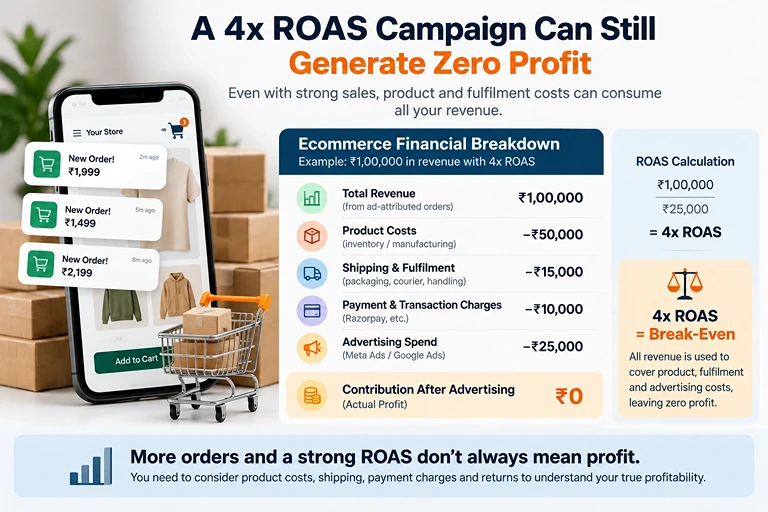
A lower-ROAS campaign can be financially better when its products generate more contribution after advertising costs.
Ecommerce business owners often assume that the campaign with the highest ROAS deserves the largest budget.
But ROAS measures revenue relative to advertising spend, not how much profit the campaign creates.
Imagine two campaigns:
Campaign A produces 5x ROAS but promotes heavily discounted, low-margin products.
Campaign B produces 3x ROAS but sells products with stronger margins and lower fulfilment costs.
Campaign B could generate more financial contribution despite its lower ROAS.
This creates an important decision for ecommerce brands: should they optimise for the highest revenue multiple or the strongest contribution?
The answer depends on business economics.
A good advertising strategy considers product margins, order quality, customer acquisition costs, and the potential value of repeat customers.
It also considers whether increasing ad spend produces enough additional contribution to justify the investment.
Google’s value-based bidding guidance explains how changing ROAS targets can affect campaign efficiency and conversion volume.
The objective should not be to maximise the ROAS figure at any cost.
It should be to generate profitable sales at a level the business can maintain.
How Ecommerce Brands Can Improve Profitable ROAS Without Increasing Ad Spend
Better product selection, accurate measurement, and fewer fulfilment losses can improve profitability without increasing advertising budgets.
When ecommerce profitability is weak, increasing advertising spend is rarely the best first response.
Businesses should identify where money is being lost and improve those areas before scaling.
Focus on products that generate better margins
Rather than promoting products only because they are popular, analyse how much each product contributes after relevant costs.
Some products may have lower sales volume but generate stronger profits.
Prioritising the right product mix can improve overall advertising economics.
Improve the website purchasing experience
A customer should be able to understand the product, delivery expectations, pricing, and return policy before purchasing.
Clear product descriptions, accurate images, mobile-friendly pages, and a simple checkout can help reduce confusion.
Businesses can also review these practical ecommerce website user experience improvements when checking their store.
Better purchase information can help customers make more confident decisions and may reduce avoidable post-purchase problems.
Increase average order value carefully
Average Order Value (AOV) measures the average amount spent per completed order.
Offering related products, relevant bundles, or suitable shipping incentives may increase the value of each purchase.
However, these offers should be evaluated after discounts and additional fulfilment costs.
Increasing order value is helpful only when it also improves contribution.
Reduce unnecessary delivery losses
Identify where COD failures, cancellations, and returns occur most often.
Review incomplete addresses, delivery communication, product expectations, and courier performance.
Improving these areas can help reduce avoidable expenses without unnecessarily restricting customer choices.
Improve tracking and reporting
Advertising platforms, store dashboards, and finance reports should use clearly defined revenue figures.
This is especially important because a recorded purchase is not necessarily a completed, retained sale.
The same measurement problem appears earlier in the customer journey, as explained in this article about the difference between leads and sales in digital marketing.
Tracking should help the business understand what actually happened, not merely what an advertising dashboard initially reported.
What Should Ecommerce Owners Review Before Increasing Their Ad Budget?
Advertising budgets should increase only after the business verifies that additional completed orders can generate positive contribution.
Before scaling campaigns, ecommerce business owners should complete two simple reviews.
Review 1: Check order-level profitability
- Compare recorded orders with delivered and retained sales.
- Calculate product costs and contribution margins.
- Include payment fees, packaging, and shipping expenses.
- Identify cancelled, refunded, and RTO shipments.
- Calculate realised-revenue ROAS and contribution after advertising.
Keep an order-level report covering a sufficiently complete delivery and return cycle.
Review 2: Check whether growth is sustainable
- Identify profitable products and customer segments.
- Review whether acquisition costs are increasing.
- Check inventory availability and fulfilment capacity.
- Compare profitable new customers with repeat purchases.
- Test budget increases gradually and review the additional contribution.
These reviews help distinguish campaigns that merely create sales activity from campaigns that support financially healthy growth.
Frequently Asked Questions About Profitable ROAS
There is no universal good ROAS. The right target depends on product margins, advertising costs, fulfilment expenses, and the profit the business needs to retain.
High advertising costs, low margins, frequent discounts, failed deliveries, and refunds can reduce earnings. Brands need to compare actual retained revenue with total relevant costs.
Yes. If the business needs more than 4x ROAS to cover variable costs and advertising, a 4x campaign can still generate losses before fixed overhead.
They can promote better-margin products, improve tracking, reduce avoidable returns, increase profitable order value, and improve website conversions.
Both matter, but profitability should guide business decisions. ROAS measures advertising efficiency, while contribution after advertising helps show whether the sales are financially worthwhile.
Getting consistent orders is an important achievement for any ecommerce business. But order growth alone does not guarantee a financially successful brand.
Strong ROAS figures can hide low product margins, costly returns, discounts, and fulfilment expenses.
For ecommerce businesses in Kerala and across India, achieving profitable ROAS requires a better understanding of how advertising, pricing, customer experience, and operations work together.
By measuring retained revenue, calculating break-even ROAS, and addressing the biggest sources of financial loss, brands can make more confident decisions about their advertising investments.
More orders can increase revenue. More profitable orders create a stronger business.
Turn More Ecommerce Orders Into Real Profit
Getting orders but struggling with profitable ROAS? It's time to look beyond your advertising dashboard.
At Addox Digital, we help ecommerce brands improve advertising performance, reduce wasted ad spend, and focus on profitable growth.
Ready to make your ecommerce advertising more profitable?
Talk to Our Digital Marketing Experts →