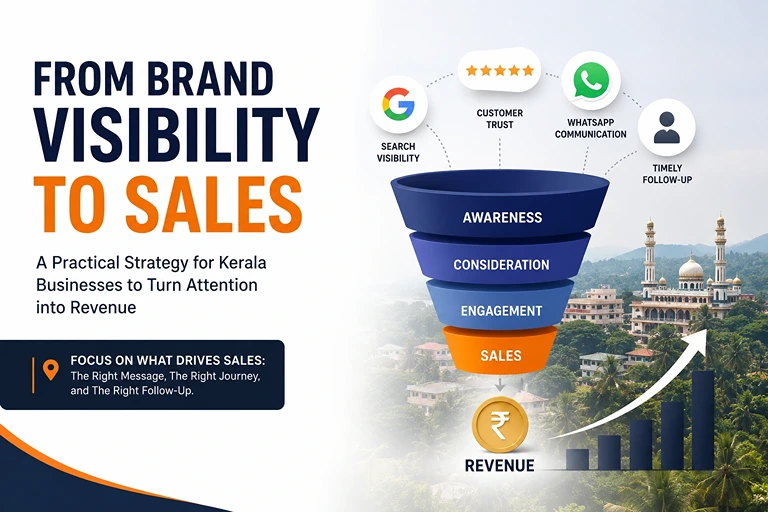
Visibility becomes commercially useful when suitable customers understand the offer, trust the business and know what to do next.
Your business may already be visible. Social media posts receive views, follower numbers are growing, people visit your website and your Google Business Profile attracts attention. Yet these numbers may not be producing enough qualified enquiries, consultations, quotations or sales.
The problem may not be reach. It may be an unclear offer, generic messaging, weak proof, inconsistent customer touchpoints, confusing landing pages or slow responses after an enquiry.
Learning how to turn brand visibility into sales requires more than publishing regularly or spending more on advertising. Customers must understand what you offer, why it is relevant, why they should trust you and how they can take the next step.
Branding is therefore not limited to a logo, colour palette or social media style. It is a connected commercial system. Every important touchpoint should help the right customer move from attention to understanding, confidence and action.
Why Brand Visibility Does Not Automatically Produce Sales
Attention creates an opportunity, but relevance, clarity and trust determine whether a customer moves closer to buying.
Visibility shows that people have seen your business. It does not confirm that they understand the offer or intend to buy.
A person may recognise your brand but have no immediate need. Another may visit your service page and leave because the process, pricing factors or availability are unclear. Someone else may like your content but select a competitor with stronger reviews or a faster response.
Kerala customers may also combine online and offline touchpoints. They may discover a company through Instagram, check Google reviews, ask a friend for an opinion, send a WhatsApp message and complete the purchase in person.
A useful brand visibility strategy does more than increase attention. It helps suitable customers recognise that the business can solve their problem and gives them enough confidence to continue.
How to Turn Brand Visibility Into Sales: Seven Practical Steps
Branding that converts connects customer insight, positioning, consistency, useful content, proof, clear action and commercial measurement.
The following framework shows how each branding activity contributes to a customer decision.
| Step | Main Business Question | Practical Outcome |
|---|---|---|
| Define the Buyer | Who has the clearest need? | More relevant targeting |
| Clarify the Promise | Why should they consider us? | Stronger positioning |
| Align Touchpoints | Are customers receiving one clear message? | Less confusion |
| Create Buying-Stage Content | What question must we answer now? | Better-informed buyers |
| Add Relevant Proof | Why should customers believe us? | Stronger trust |
| Use One Main CTA | What should customers do next? | More focused action |
| Connect Marketing & Sales | Which activity creates revenue? | Better decisions |
Define the Buyer and Buying Situation
A specific buying situation gives your brand more direction than a broad audience description based only on age or location.
Descriptions such as “business owners in Kerala” or “people aged 25 to 45” are usually too broad to guide effective messaging. They do not explain why customers are searching, what they want or what may stop them from buying.
Define the audience through a real situation. Identify the problem that starts the search, the desired outcome, the options being compared and the concerns delaying the decision.
An interior firm could focus on apartment owners who need clear budget guidance and managed installation before moving into a new home. This is more useful than targeting every homeowner in a city.
Action: Speak to five recent customers. Ask what started their search, what they compared, what concerned them and why they chose your company.
Build the Brand Around One Clear Promise
A focused promise helps suitable customers recognise the value of your offer and decide whether it matches their needs.
Statements such as “quality service at affordable prices” are too general. They sound similar to competitor messages and do not explain why someone should continue.
Build the promise around this formula:
Customer + problem + outcome + credible difference
A B2B supplier could say:
We help Kerala retailers reduce stock delays through scheduled supply and responsive local support.
The message identifies the customer, problem, outcome and reason to consider the supplier. It also gives marketing and sales teams one consistent explanation of the offer.
Avoid promises the business cannot support. Specific positioning should create clarity, not unrealistic expectations.
Action: Ask three employees and three customers to explain what your company does. When their answers differ widely, simplify the message.
Keep Important Customer Touchpoints Consistent
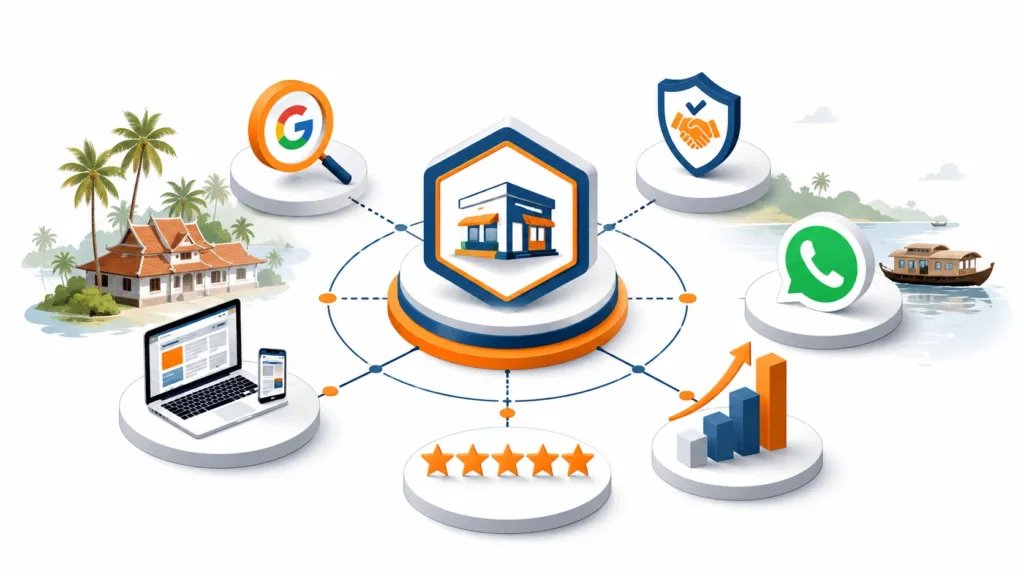
Consistent information across search, website, WhatsApp and sales communication reduces doubt before customers make a decision.
Consistent brand messaging does not mean copying the same content everywhere. It means keeping the core promise, service details and customer expectations aligned.
Focus on the touchpoints most likely to influence a purchase: your website, Google Business Profile, WhatsApp communication and sales materials. Conflicting opening hours, service areas, prices or availability can make customers hesitate.
Google recommends keeping Business Profile information complete, accurate and current so customers can understand what a business offers and when it operates. Read the official Google Business Profile guidance.
A Kozhikode service provider may use Malayalam videos, an English website and bilingual WhatsApp messages. The language changes, but the offer and service conditions should remain consistent.
Action: Audit these four touchpoints and correct any conflicting descriptions, contact details, service areas or next steps.
Create Content for Each Stage of the Buying Journey
Content supports sales when it answers the questions customers ask as they move from awareness to serious consideration.
Not everyone who sees your brand is ready to request a quotation. Some people are identifying a problem, some are comparing options and others are close to acting.
Create content for three stages:
- Awareness: Explain problems, mistakes and common questions.
- Consideration: Show processes, comparisons, pricing factors or results.
- Purchase: Explain availability, timelines, service details and next steps.
An education provider could publish a Malayalam video about career options, an article comparing course formats and an admissions page showing schedules, fees and application steps. Each asset supports a different decision.
Action: Review your last 20 pieces of content. Label each as awareness, consideration or purchase. Create one useful asset for the weakest stage.
Replace Generic Claims With Relevant Proof
Evidence from real customers and completed work is more persuasive than broad statements about quality, experience or trust.
Words such as “trusted,” “experienced” and “customer-focused” carry little weight without supporting evidence.
Focus on a few useful proof types: detailed customer reviews, case studies or project examples, and visible process proof. The strongest evidence usually reflects the buyer’s own industry, location or situation.
Google notes that reviews can help a business stand out and provide useful information to potential customers. It also recommends replying to reviews and keeping business details current. See Google’s customer review guidance.
Paid promotions must be transparent. The ASCI Influencer Guidelines require suitable disclosure labels for promotional influencer content.
An architecture firm could publish a project story explaining the client’s needs, design decisions, budget factors, timeline and completed result.
Action: Replace three unsupported website claims with customer evidence, project details or process proof.
Give Customers One Clear Next Action
One relevant call to action gives interested customers a clearer route forward than several competing choices.
Customers should not have to guess what to do after reading a service page.
Several competing instructions—call, subscribe, follow, download, visit and message—can make the next step harder to identify. Choose one primary call to action that matches the natural beginning of your sales process.
Useful options include:
- Request an itemised estimate
- Book a consultation
- Ask about availability on WhatsApp
- Schedule a site visit
Make the wording specific. “Book a 20-minute consultation” explains more than “Get started.”
A manufacturing supplier may receive better qualified enquiries through a short form asking about quantity, delivery location and required date instead of using a general contact button.
Action: Select one primary call to action for every important commercial page and place it where customers can easily find it.
Connect Marketing Activity With Sales
Marketing becomes commercially accountable when lead sources, sales stages, outcomes and revenue are recorded in one process.
Marketing reports often focus on reach and clicks, while sales teams focus on proposals and revenue. A practical sales conversion strategy connects both.
For every enquiry, record the lead source, qualification status, sales stage, final outcome and revenue.
Google Analytics can mark important website actions, such as enquiry-form submissions, as key events. See the official Google Analytics key-event guidance.
Website analytics will not capture the full journey when customers call, use WhatsApp, visit a store or pay offline. These interactions should be recorded in a customer management system or a simple shared sheet.
A restaurant may discover that Instagram produces more messages while Google Search produces fewer but more purchase-ready enquiries.
Action: Track every enquiry for 30 days using one source list and a shared sales-status record.
A Typical Kerala Customer Journey
Kerala customers may combine online discovery, local recommendations, bilingual conversations and offline transactions before making a purchase.
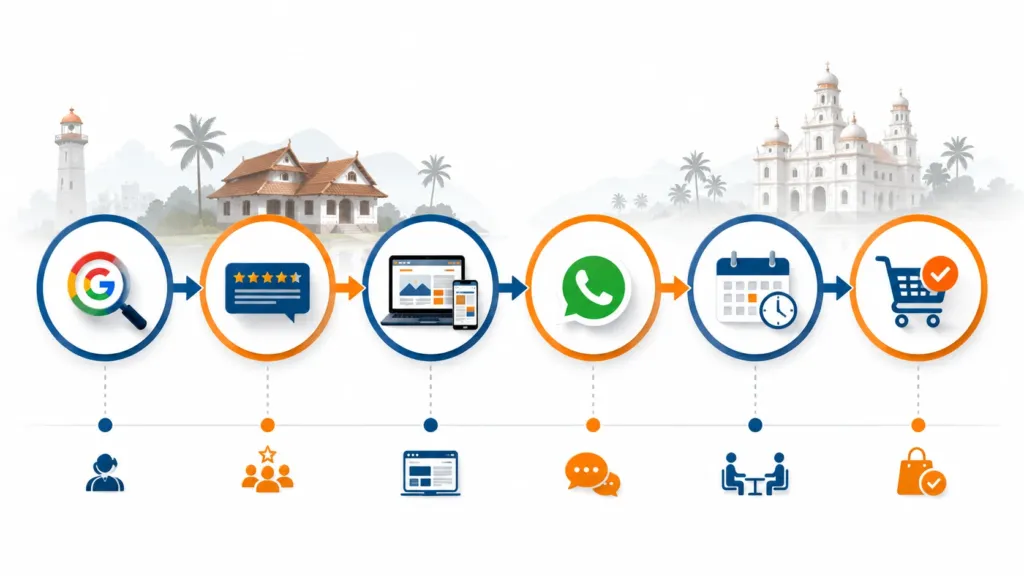
A typical journey may look like this:
Instagram or Google Search → Reviews → Website → WhatsApp → Consultation or Quotation → Follow-up → Purchase
This is an illustrative path rather than a rule for every customer.
| Customer Stage | What the Customer May Check | What the Business Should Provide |
|---|---|---|
| Instagram or Google Search | Relevance and first impression | Clear message and useful content |
| Reviews | Reputation and customer experience | Genuine reviews and helpful replies |
| Website | Services, process and suitability | Focused service page with proof |
| Availability and quick clarification | Prompt, structured response | |
| Consultation or Quotation | Scope, price and next steps | Clear expectations and terms |
| Follow-up | Remaining questions and confidence | Useful, timely communication |
| Purchase | Final value and convenience | Simple payment or onboarding process |
A customer may discover a company through Instagram or Google, then read reviews or ask friends and family for recommendations. The website should explain the offer, process and service area, while WhatsApp provides a convenient way to ask questions.
Language may change during the journey. Discovery content or early conversations may happen in Malayalam, while quotations and technical documents are shared in English. The final payment may happen offline.
Reviewing this complete journey gives a more accurate picture than judging performance through social media engagement alone.
Applying This Brand-to-Sales Strategy in Perinthalmanna
Perinthalmanna businesses can improve local conversions by connecting search visibility, customer proof, WhatsApp communication and timely follow-up.
For businesses in Perinthalmanna, customer visibility often begins through Google Search, Google Maps, Instagram, personal recommendations or direct local enquiries. Customers may then check reviews, visit the company’s website and contact the business through WhatsApp before requesting a quotation, booking a consultation or visiting in person.
A Perinthalmanna-focused service page should support this journey by clearly explaining:
- The services available in Perinthalmanna
- The types of customers or industries the business supports
- The local service area and availability
- Relevant customer reviews, results or completed work
- The next step for requesting a consultation or quotation
Businesses that want to strengthen local discovery and generate more relevant enquiries can explore our Digital Marketing Agency in Perinthalmanna.
For companies that depend heavily on Google Search and Maps, our explains how local visibility can be connected with reviews, website visits and customer enquiries.
The goal is not simply to mention Perinthalmanna several times. The page should give local customers enough information, proof and clarity to decide whether the business is suitable for their needs.
Common Mistakes That Prevent Visibility From Becoming Sales
Visibility is often lost when customers encounter vague messaging, weak evidence, confusing pathways or inconsistent enquiry handling.
- Treating reach as revenue: Views and impressions measure exposure, not buying intent. Track how many suitable customers enquire and progress towards a sale.
- Using generic messaging: Phrases such as “quality solutions” do not explain who the business serves or why it deserves consideration.
- Sending every visitor to the homepage: Direct people to a page that answers questions about the specific service they are considering.
- Making unsupported claims: Replace vague statements about quality or trust with customer evidence, completed work or process information.
- Using too many calls to action: Several competing choices make the next step harder to identify. Give each commercial page one main action.
- Ignoring response time and follow-up: Strong marketing cannot correct slow replies, incomplete answers or missed follow-ups.
- Discounting before fixing trust: Lower prices cannot repair unclear positioning or weak proof. Frequent discounts may encourage customers to delay buying.
A 30-Day Visibility-to-Sales Action Plan
A focused four-week review can reveal where customer attention is being lost and turn findings into practical improvements.
Week 1: Review the Audience and Positioning
Define the main buyer, buying situation and problem. Review recent enquiries and speak to customers about what influenced their decisions.
Expected outcome: One positioning statement explaining who you serve, what problem you address and why the offer is relevant.
Week 2: Correct Customer Touchpoints
Review the website, Google Business Profile, social profiles and WhatsApp communication. Correct conflicting details and test the enquiry experience yourself.
Expected outcome: A consistent message and accurate information across the channels customers are most likely to check.
Week 3: Create Content and Proof
Produce one awareness asset, one consideration asset, one proof-based example and one purchase-focused page or message.
Expected outcome: Useful content that supports customer decisions instead of repeatedly asking for a sale.
Week 4: Improve Action and Follow-Up
Choose one main call to action for each commercial page. Create a basic lead tracker and review response times, proposal progress and lost-sale reasons.
Expected outcome: A clearer process connecting marketing attention with qualified enquiries and sales activity.
How to Measure Brand-Led Sales
Qualified enquiries, sales progress and attributed revenue provide a clearer commercial picture than impressions or follower counts alone.
Use metrics that show movement towards a sale.
| Metric | What It Shows |
|---|---|
| Qualified Enquiries | Enquiries from people who match the target customer and have a realistic need. |
| Lead Qualification Rate | Percentage of enquiries considered suitable opportunities. |
| Consultation or Proposal Rate | Percentage of qualified leads reaching a serious discussion. |
| Sales Close Rate | Percentage of qualified leads becoming customers. |
| Customer Acquisition Cost | Marketing and sales cost required to gain one customer. |
| Attributed Revenue | Revenue connected to a recorded marketing source. |
| Response Time | Time taken to provide a useful first reply. |
| Reasons for Lost Sales | Main reasons customers do not proceed. |
Review these metrics monthly and look for patterns.
A channel producing fewer enquiries may still be useful when those leads are more relevant and close at a higher rate. Lost-sale reasons can reveal problems involving price, timing, service availability or follow-up.
The aim is not to give one channel full credit for every purchase. It is to understand which touchpoints support progress and where suitable customers are dropping out.
Frequently Asked Questions
❓How does brand visibility generate sales?
Visibility introduces customers to a business. Sales become more likely when the offer is relevant, easy to understand and supported by credible proof. Customers also need a simple way to enquire and a useful response after making contact.
❓Should conversion problems be fixed before increasing awareness?
Yes, major conversion gaps should be corrected first. Ensure that service pages answer customer questions, proof is visible and the enquiry process works. Wider visibility is more useful when the business is ready to handle interest.
❓How long does branding take to affect sales?
The timeline depends on price, buying risk and the sales cycle. Restaurants and retailers may see changes sooner than architecture, manufacturing or B2B services. Track enquiry quality and sales progress before judging revenue impact.
❓ Does consistent branding mean publishing identical content everywhere?
No. Formats and languages can change across platforms. A company may use Malayalam videos, English website pages and bilingual WhatsApp communication while keeping the same promise and service information.
❓Which social proof works best for Kerala businesses?
Detailed reviews and examples from customers with similar needs, industries or locations are often useful. Project photographs, process explanations and customer stories can also reduce doubt when they are genuine and relevant.
❓Is WhatsApp a suitable sales call to action?
WhatsApp works well when customers want quick clarification or conversational support. Use a clear greeting, ask a few qualification questions and record the source and outcome of serious enquiries.
Visibility produces commercial value when each important touchpoint helps customers move from recognition to confidence and meaningful action.
Understanding how to turn brand visibility into sales requires more than attracting attention. Customers need to understand the offer, trust the evidence and find a clear route towards a decision.
Your website, content, Google Business Profile, WhatsApp communication and sales follow-up should support the same journey. When these touchpoints are disconnected, suitable buyers may notice the business but fail to continue.
Addox Digital helps Kerala businesses identify where customer attention is being lost and create a clearer path from visibility to qualified enquiry and sale. The review can cover messaging, content, proof, landing pages, enquiry handling and follow-up without relying on exaggerated promises.
Ready to Grow Your Business?
Get a customised marketing strategy that attracts more qualified customers.
Book a Free Consultation