
Every enquiry should have one owner, one next action, and one clear deadline.
Many businesses assume they need more leads when the real problem begins after an inquiry arrives.
A prospect may submit a website form, call the office, send an email, or begin a WhatsApp conversation. The business may reply once, but nobody records what should happen next. A quotation is sent without a follow-up date. An employee forgets to return a call. Two team members assume the other person is responsible.
A simple lead follow-up system prevents these gaps. It gives every inquiry a clear owner, a current status, a next action, and a deadline.
Businesses researching how to automate lead generation often focus on advertisements, landing pages, forms, and chat tools. These methods can bring prospects into the business, but they cannot guarantee that someone will follow up properly.
A complete sales process needs both lead capture and lead follow-up. Lead capture brings the enquiry into the business. Lead follow-up ensures that the enquiry receives a useful response, a clear next step, and a final outcome.
The purpose is not to send more messages. It is to make sure every suitable inquiry receives timely and consistent communication until the customer makes a decision.
Why Enquiries Get Lost After First Contact
Most enquiries are lost during handovers, not when they first enter the business
A website enquiry may reach a shared inbox that several employees can access. Because no single person is responsible, everyone assumes somebody else will reply.
A WhatsApp enquiry may receive a quick answer, but the customer’s requirement is not recorded anywhere else. If the employee handling the chat is absent the next day, another team member may not know what was discussed.
A quotation may be prepared and sent correctly, but no follow-up task is created. The salesperson waits for the customer, while the customer may be waiting for more information or guidance.
In each situation, the business records the previous activity but does not define the next one.
A reliable follow-up process must answer three questions at all times:
- Who owns this enquiry?
- What must happen next?
- When should that action be completed?
When these answers are clear, enquiries are less likely to remain unanswered or inactive.
Lead Capture Is Not Lead Follow-Up
Lead capture creates an opportunity; follow-up keeps that opportunity moving.
Lead capture records that a person has shown interest in a product or service.
Lead follow-up manages what happens after that interest is recorded.
A business can have a strong website, active advertising campaigns, and many incoming enquiries while still producing weak sales results. The problem may not be the number or quality of leads. It may be inconsistent follow-up.
Lead generation brings people into the business. Follow-up keeps those people connected to a responsible employee, a conversation history, and a clear next step.
Without this continuity, even a successful marketing campaign can produce enquiries that are forgotten.
Before increasing the advertising budget, a business should first check whether its current enquiries are being handled properly.
Connect Lead Generation With a Strong
Follow-Up Process
Better marketing creates value only when every new enquiry enters a clear follow-up system.
Generating enquiries through SEO, Google Ads, Meta Ads, social media, or landing pages is only the first step. The business also needs a process to capture each lead, assign ownership, send reminders, and track the final result.
For businesses that need support with both enquiry generation and sales follow-up, working with a digital marketing agency in Perinthalmanna can help connect marketing channels with CRM tracking, WhatsApp alerts, and follow-up workflows. Addox Digital’s page specifically presents lead generation, CRM setup, lead tracking, instant routing, and follow-up automation as parts of its growth approach.
Build the CLEAR Follow-Up System
Capture, Label, Engage, Automate, and Review every enquiry through one repeatable process
The CLEAR Follow-Up System provides a simple structure for managing enquiries.
CLEAR stands for:
- Capture
- Label
- Engage
- Automate
- Review
The system can work inside a spreadsheet, customer relationship management system, project-management tool, or internal database. The software may change as the business grows, but the operating process should remain clear.
Capture every enquiry
Every enquiry should enter one shared register.
Customers may continue using phone, email, WhatsApp, website forms, social media, or referrals. The business simply needs one internal place where the important details are stored.
Each enquiry should include the customer’s name, contact information, enquiry source, date received, and a short description of the requirement.
A unique enquiry number can prevent confusion when the same person contacts the business through several channels.
The shared register should remain the main business record. Personal inboxes and chat applications may still be used for communication, but essential information should not remain only inside them.
Label the owner and status
Every enquiry should have one named owner.
Assigning an enquiry to “sales,” “front office,” or “the team” does not create clear responsibility. One person should be responsible for ensuring that the next action happens, even when another employee helps with part of the work.
The inquiry should also have a clear status.
Useful statuses include new, first response sent, information required, meeting scheduled, quotation in preparation, quotation sent, decision pending, follow up later, won, and closed.
Avoid vague labels such as “good lead,” “warm,” or “very interested.” Different employees may interpret these descriptions differently.
A clear status should explain what happened and what should happen next.
For example: Quotation sent on 15 June. Follow-up due on 18 June.
Engage through a planned schedule
Follow-up should not depend on memory.
After every meaningful conversation, the owner should record the next action and its deadline.
The next action may involve sending a brochure, preparing a quotation, confirming availability, arranging a meeting, calling after an internal discussion, or sending a revised proposal.
A useful follow-up should move the conversation forward. It should answer a question, reduce uncertainty, provide information, or offer a clear choice.
A message that only says “Any update?” gives the customer little reason to respond.
Automate routine administration
Automation is most useful when it removes repetitive administrative work.
A basic system can automatically confirm receipt of an enquiry, create a new record, assign an owner, or send a reminder before a deadline.
It can also alert a manager when an enquiry has no owner or when a quotation has not been followed up.
Automation should not suggest that a person has reviewed an enquiry when that has not happened.
Example acknowledgement:
Thank you for contacting us. We have received your enquiry. A team member will review it and respond before 11:00 a.m. tomorrow.
Important conversations should remain human-led, especially when the customer has an unusual requirement, raises an objection, requests a price change, or reports a problem.
Review actions and outcomes
A follow-up system should not become a storage file that nobody checks.
The team should regularly review new enquiries, actions due today, overdue tasks, quotations awaiting follow-up, and records without recent activity.
Every enquiry should eventually receive a final outcome.
Possible outcomes include won, lost because of price, lost because of timing, lost to another provider, unsuitable requirement, invalid contact, future follow-up, or customer requested no further contact.
A final outcome helps management understand whether an enquiry was genuinely lost or simply left unfinished.
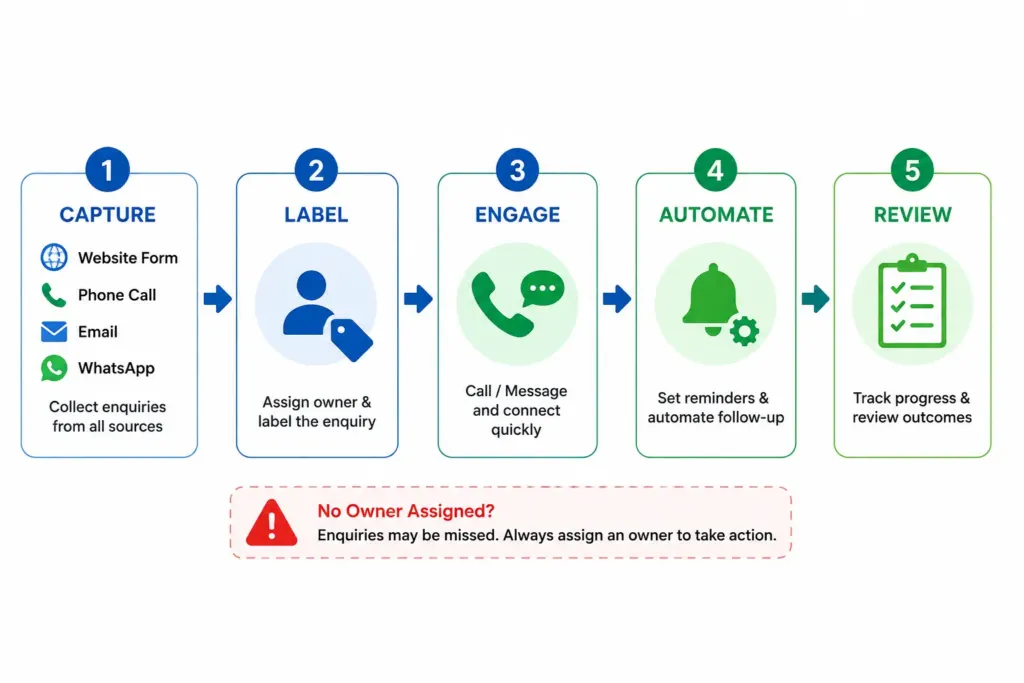
Use the No-Orphan Rule
No open enquiry should remain without an owner, a next action, or a deadline.
An orphan enquiry is an open enquiry that has no clear owner, next action, or due date.
The rule is simple:
No orphan enquiry should remain in the system at the end of the working day.
Before the team finishes work, it should confirm that every new enquiry has an owner and every open enquiry has a dated next step.
This daily habit is often more useful than adding advanced software. It prevents records from remaining active without responsibility.
The no-orphan rule also makes management reviews easier. Instead of asking employees to remember what happened, the manager can inspect the shared record and see the current status immediately.
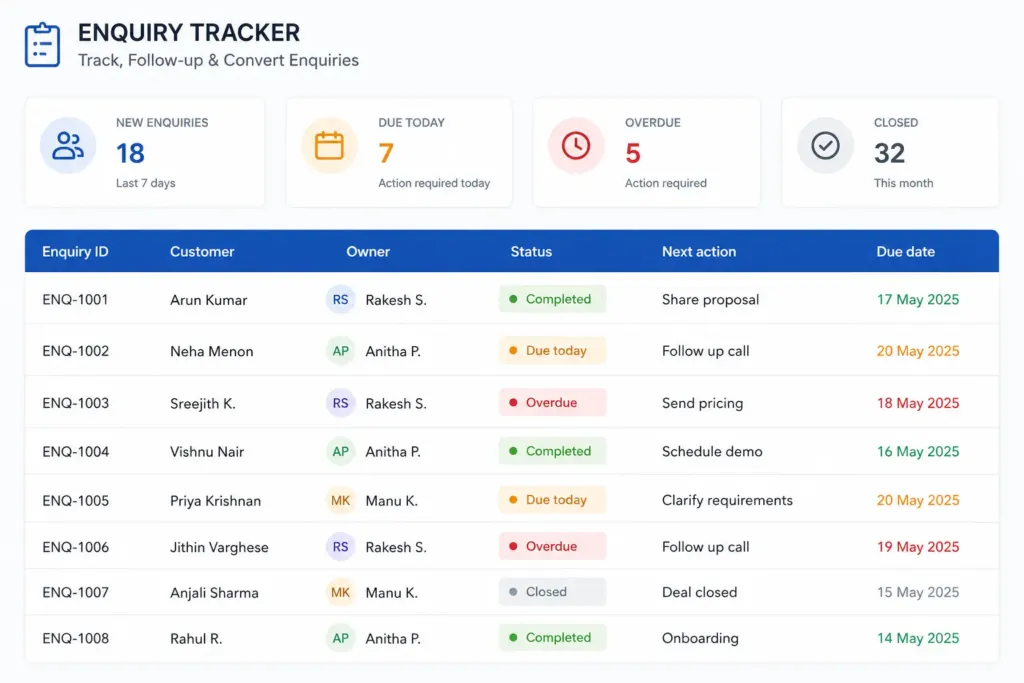
Build a Simple Enquiry Tracker
A useful tracker records only the information needed to continue the inquiry.
A tracker should make follow-up easier. It should not create unnecessary administrative work.
The system should contain enough information for another authorized employee to understand the inquiry and continue the conversation when necessary.
Field | Example | Purpose | Update |
Enquiry details | ENQ-041, Website | Identify the record | When received |
Owner and status | Rahul, New | Set responsibility | Immediately |
Next action | Send quotation | Prevent delay | After contact |
Outcome | Won or closed | Track the result | On status change |
Required information should include the customer’s name, contact method, requirement, owner, status, next action, and deadline.
Details such as estimated budget, preferred completion date, product category, location, and referral source can remain optional.
Collecting too much information can reduce staff participation. When updating the tracker takes too long, employees may begin keeping private notes outside the system.
The tracker should be simple enough to update immediately after a meaningful call, message, or meeting.
Keep One Record When Channels Change
One customer journey should remain inside one shared enquiry record.
A customer may begin with a website form, continue through WhatsApp, speak by phone, and receive a quotation by email.
These interactions should not become four separate enquiries.
The shared record should include a short contact history, such as:
Website form received → requirement confirmed on WhatsApp → discovery call completed → quotation emailed → follow-up due Wednesday.
The record does not need a full transcript of every conversation. It needs enough information for another authorised employee to understand what happened and what should happen next.
Keeping one record also helps prevent duplicate calls, repeated questions, and conflicting promises.
When the customer changes channels, the enquiry owner should update the same record rather than creating a new one.
Create a Daily Action View
A follow-up system should show employees what requires attention today.
A spreadsheet or CRM should not force employees to search through every record each morning.
The system should provide clear views for new inquiries, unassigned records, actions due today, overdue tasks, quotations awaiting follow-up, future reminders, and inquiries ready to close.
A daily action view turns the tracker into a working tool rather than a database that is updated only before management meetings.
The team should begin each day by reviewing urgent and overdue work. Before closing the day, it should check for enquiries without owners or next actions.
This routine reduces dependence on memory and helps employees focus on the records that need immediate attention.
Avoid Repetitive Follow-Up Messages
Every follow-up should add value or make the next decision easier.
Repeatedly sending “Just following up” does not help the customer move forward.
A useful message may clarify a price difference, answer a technical question, share a requested document, offer meeting times, or confirm whether the customer’s timeline has changed.
The purpose of follow-up is not to remind the customer that the business exists. It is to reduce uncertainty and create a clear next step.
Five fast reminders are not better than one useful message sent at the right time.
A good employee should review the previous conversation before contacting the prospect. This helps avoid repeated questions and irrelevant information.
Choose Between a Spreadsheet and CRM
The right tool is the simplest one that protects ownership, history, and next actions
A spreadsheet is not automatically unprofessional, and a CRM is not automatically organised.
A shared spreadsheet can be enough when one to three employees handle enquiries, the sales process has only a few stages, and the team updates records consistently.
A spreadsheet may include separate views for new enquiries, open enquiries, actions due, and closed records.
A CRM becomes more useful when several employees need access to the same customer history, ownership changes regularly, duplicate records create confusion, or management needs detailed activity reports.
Advanced workflows make sense only after the manual process is clear. Automating a poorly defined process usually creates faster confusion.
Before purchasing complex software, a business should first create one shared tracker, require an owner, require a next action, and build a daily overdue view.
The first useful automation is often an overdue-task reminder rather than an automatically written sales message.
The tool should support the process. It should not become the process.
Keep Calls, Email, and WhatsApp Consistent
Consistency means keeping the same facts, promises, and next step across every channel.
A customer should not need to repeat the full requirement whenever the conversation moves to another employee or channel.
The shared record should show what the customer requested, what the business promised, what information was sent, who owns the enquiry, and when the next action is due.
Consistency does not mean copying the same sentence across phone, email, and WhatsApp. It means keeping the facts and next step aligned.
This creates a smoother customer experience and reduces the risk of two employees providing different information.
A short note after each meaningful interaction is usually enough. The note should explain what changed and what needs to happen next.
Use the purpose–progress–prompt method.
A good follow-up message should explain the reason, show progress, and request one clear action.
A useful follow-up message can be written using three parts: purpose, progress, and prompt.
The purpose explains why the business is contacting the customer.
Example: I am following up on the website quotation sent on Monday.
The progress explains what has happened or provides useful information.
Example: We have included the payment-gateway option you requested.
The prompt asks one clear question or offers a simple choice.
Example: Would you like annual maintenance shown as a separate option?
The complete message would read:
A first response may ask the customer to confirm one relevant detail. A quotation follow-up may offer a call or a revised option. A later message may ask whether the enquiry should remain open or be scheduled for a future date.
Templates should guide employees, but they should not make every conversation sound identical.
Use WhatsApp Without Losing Business Context
WhatsApp can support communication, but the shared system should remain the main business record.
WhatsApp can provide fast and convenient communication, but important details should not remain only inside the chat.
After a meaningful WhatsApp conversation, the employee should update the shared record with what the customer confirmed, what the business promised, who owns the next step, and when the action is due.
Simple labels such as “new inquiry,” “quotation sent,” “waiting for customer,” “follow-up due,” and “closed” can help organize conversations.
Too many labels can create confusion. The team should use a small set of clearly defined options.
The business should also avoid allowing customer information to remain only on personal devices. Essential details should be available to authorized employees through the shared system.
Automate Reminders Without Losing the Human Connection
Automate administrative work before automating customer persuasion.
Automation is most useful when it removes repetitive coordination work.
Receipt confirmations, record creation, owner assignment, due-task reminders, overdue alerts, and closure requests are suitable early automations.
Automation is less reliable when it attempts to understand a complex customer requirement without enough context.
Conversations involving objections, complaints, price changes, unusual requirements, or delivery promises should remain human-led.
Before activating any workflow, the business should ask whether the message could be triggered with incomplete information, whether an employee can pause it, and whether the customer might receive duplicate communication.
The business should also check what happens outside normal working hours. An automated message should set an honest expectation rather than promising immediate action when no employee is available.
The first automation most businesses need is a missed-action warning, not an AI-written follow-up message.
Test the system with ten inquiries.
Testing ten real enquiries can reveal process gaps before the business invests in new software.
Before purchasing a CRM or increasing advertising spend, test the process using ten recent enquiries.
For Addox Digital, this could include a mix of website forms, phone calls, email, referrals, social media, and WhatsApp conversations.
Each enquiry should have a received date, source, prospect name, requirement, owner, next action, and deadline.
After the test, check whether all ten enquiries had named owners, whether every open enquiry had a next action, and whether any customer received duplicate communication.
Ask one question for every record:
Could another authorised employee continue this enquiry correctly tomorrow?
When the answer is no, the record is missing important context, ownership, a document, a next action, or a deadline.
The ten-enquiry test is not large enough to prove long-term sales improvement. Its purpose is to reveal process gaps before the business invests more time or money.
The results can then guide the next improvement. The business may need clearer ownership, fewer statuses, better reminders, or a simpler tracker
Create a Daily and Weekly Follow-Up Routine
Daily control prevents missed actions, while weekly review improves the complete process.
The daily routine should focus on new enquiries, missing owners, actions due today, overdue tasks, and quotations waiting for follow-up.
Employees should update the record after meaningful conversations and close enquiries that no longer have a valid next step.
The weekly review should examine older open records, completed follow-ups, lost-sale reasons, duplicate customer contact, and automation errors.
Management should be able to identify who owns every open enquiry, which prospects are waiting for the business, and which actions are overdue.
The review should also look for repeated problems. If several enquiries remain unassigned, the assignment rule may be unclear. If quotations are sent but rarely followed up, the process may need an automatic reminder.
Asking employees whether they followed up is not a control system. The shared record should already contain the answer
Frequently Asked Questions
A follow-up system can begin simply, but ownership and next-action rules must remain strict.
A lead follow-up system records every enquiry, assigns an owner, schedules the next action, and tracks the final result. It can operate through a spreadsheet, CRM, or connected set of tools.
No. Lead generation attracts or captures potential customers. Lead follow-up manages communication after an inquiry arrives.
Yes. A shared spreadsheet can be enough when the team and sales process remain manageable. Clear ownership and regular updates are more important than the tool itself.
A CRM becomes useful when several employees need the same customer history, ownership changes regularly, or reporting requires too much manual work.
Start with receipt confirmations, record creation, owner assignment, reminders, and overdue alerts. Keep complex sales conversations under human control.
There is no universal number. The team should use a planned schedule, make each message useful, and stop when the customer declines or requests no furthe
Conclusion
Better follow-up can create more value from existing inquiries before the business spends more on marketing.
A business does not need to begin with complicated automation.
It needs a reliable answer to three questions: Who owns the inquiry? What happens next? And when is the action due?
The CLEAR Follow-Up System provides a practical structure. Capture every inquiry, label its owner and status, engage through useful communication, automate routine reminders, and review overdue work and final outcomes.
The process can begin with a spreadsheet and move to a CRM when the team or inquiry volume becomes more complex.
The most important improvement is not new software. It is a working habit in which no inquiry is left without responsibility or a next step.
A consistent process can help the business respond more clearly, build trust with prospects, and convert more of the inquiries it already receives.
Addox Digital can help you organize inquiries, assign clear ownership, and set up a simple follow-up process that prevents missed opportunities.