If Facebook ads are not generating leads, the first fix is diagnosis, not more spend.
When Facebook ads are not generating leads, many business owners think the answer is simple: spend more.
That sounds logical. More budget should bring more reach. More reach should bring more clicks. More clicks should bring more leads. More leads should bring more sales.
But real campaigns do not work in such a straight line.
Ad budget is only one part of growth. If targeting is weak, the ads reach the wrong people. If the offer is unclear, serious buyers ignore it. If the landing page is thin, visitors do not trust it. If the sales team replies late, hot leads turn cold.
So the problem is not always the campaign. Sometimes the campaign is exposing a broken sales path.
Unpopular truth:
Scaling a weak funnel does not create growth. It creates faster leakage.
Why More Ad Budget Does Not Always Bring Better Sales
More budget helps only when the funnel can turn paid attention into qualified sales opportunities.
More ad budget does not always bring better sales because ads can only bring attention. They cannot repair every step after the click.
A Facebook campaign can fail for five common reasons:
- It reaches the wrong people.
- It attracts people who only want the lowest price.
- It sends traffic to a page that does not build trust.
- It collects leads without checking buyer fit.
- It depends on a sales process that replies too late.
That is why the question should not be
“How much more should we spend?”
The better question is
“How much of our current spend reaches real buyers?”
Ad budget is fuel. The sales journey is the engine. If the engine is weak, adding more fuel will not fix the ride
The Lead Truth System
Most businesses do not have an ad budget problem; they have a lead truth problem.
Before increasing ad spend, use a simple system to check whether the current campaign is producing real opportunities.
The Lead Truth System has four parts:
- Lead Truth Number: How many leads are actually qualified.
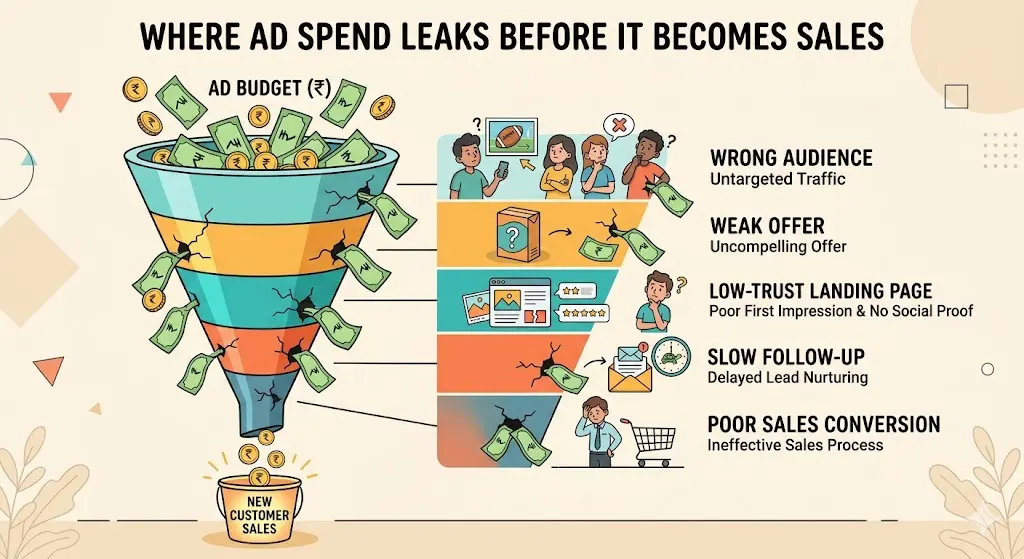
- Budget Burn Map: Where ad money leaks before sales happen.
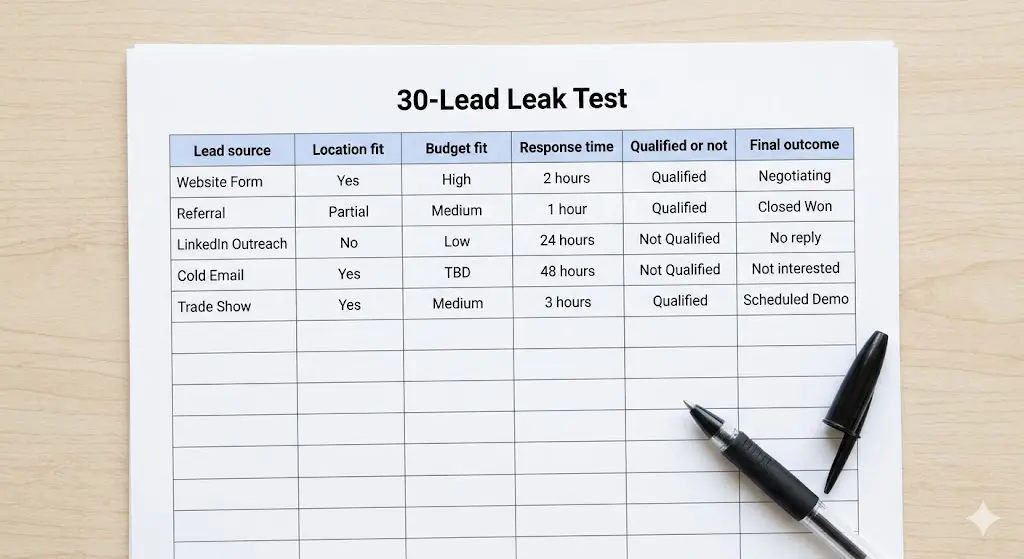
- 30-Lead Leak Test: A manual audit before scaling.
- Sales Quality Gate: A checklist before increasing budget.
This system helps business owners stop guessing. Instead of asking whether Facebook ads are working, you ask where the money is getting stuck.
The Lead Truth Number
Lead quality should be measured before budget is increased.
Use this formula before increasing your ad budget:
Lead Truth Number = Qualified Leads ÷ Total Leads × 100
Metric | Example |
Total leads | 100 |
Qualified leads | 24 |
In this example, the Lead Truth Number is 24%.
That means 76 out of 100 leads are not strong sales opportunities.
Now imagine you double your budget. You may get more leads, but if the quality stays the same, your team will also get more poor-fit conversations, more missed follow-ups, and more wasted time.
Trade-off: A stricter campaign may reduce total lead count, but it can improve sales-team productivity.
Myth vs Fact: Ad Spend vs Sales Quality
Low-cost leads are not always better leads.
Myth | Fact |
More budget means more sales | More budget means more traffic |
Cheap leads are always good | Cheap leads can waste sales time |
Ads are always the issue | The leak may be in follow-up |
More leads means growth |
Many businesses judge campaigns too early. They see a low cost per lead and assume the campaign is successful.
But the real test is not lead count. The real test is whether those leads become serious inquiries, appointments, calls, store visits, or sales.
Local detail: In Kerala and other Indian local markets, many buyers compare vendors on WhatsApp before deciding. A late reply can lose a lead even if the ad worked.
Where Ad Budget Usually Leaks
Facebook lead problems usually come from several small leaks, not one big failure
1. Audience Leak
Your ads may be reaching people who are too broad, too far away, or not ready to buy.
For example, a local clinic, academy, or interior firm may get inquiries from people outside its service area. The lead count may look good, but the sales value stays low.
2. Offer Leak
People may see the ad but not understand why they should act now.
A weak offer says:
“Contact us for more details.”
A stronger offer says the following:
“Book a free consultation for home interior planning in Kochi this week.”
The second offer is clearer. It tells the buyer what they get, where it applies, and what to do next.
3. Landing Page Leak
A visitor clicks your ad, but the page does not build trust.
Common issues include:
- No clear headline
- No proof or reviews
- Slow page loading
- No location details
- No price range or service clarity
- Confusing call-to-action
A homepage is usually too broad for paid traffic. A campaign landing page should answer one buyer need clearly.
4. Form Leak
If the form is too easy, you may get more leads but lower quality.
Asking only for name and phone number may increase volume. But it may also bring people who are not serious.
Adding one or two qualifying questions can improve quality.
Examples:
- What service do you need?
- What is your location?
- When do you want to start?
- What is your budget range?
5. Follow-Up Leak
Many good leads are lost after they submit the form.
The lead may be ready now. But if the business replies after three hours, the buyer may have already contacted a competitor.
For local services, speed matters.
6. Sales Leak
Sometimes the ad is working, the lead is valid, and the page is good. But the sales conversation is weak.
Common sales issues include:
- No call script
- No follow-up reminder
- No WhatsApp message template
- No clear next step after the first call
Unpopular truth: Sometimes the media buyer gets blamed for a sales process problem.
The Budget Burn Map
Fix ad spend leaks before increasing budget.
Use this map before increasing the budget.
Leak | Fix |
Audience | Narrow location and buyer fit |
Offer | Make the promise clear |
Page | Add proof and clear CTA |
Form | Add qualifying questions |
Follow-up | Reply faster |
Sales |
This table helps you find the real issue.
If the problem is landing page trust, budget will not fix it. If the problem is slow follow-up, a budget will not fix it. If the problem is poor sales handling, budget will not fix it.
More spend should come after the leak is found.
The 30-Lead Leak Test
small lead audit can reveal whether the real problem is ads, offer, or sales follow-up.
Before increasing ad spend, review your last 30 leads.
This is simple, but it gives clear answers.
Do this now:
- Step 1: Export the last 30 Facebook leads.
- Step 2: Check whether each lead is qualified or not.
- Step 3: Check whether each lead was contacted fast.
- Step 4: Calculate the Lead Truth Number.
- Step 5: Note the top reasons leads did not convert.
Proof you keep: Lead sheet, call log, CRM screenshot, WhatsApp response record, and date.
Simple 30-Lead Audit
Lead Type | Meaning |
Qualified | Good fit and sales-ready |
Unqualified | Poor fit or low intent |
Keep the audit simple. You do not need too many columns. First, check whether the lead is qualified or unqualified. Then check why the lead did not become a sale.
During a local SMB campaign review, Addox Digital used this type of lead audit before recommending any budget increase. The result was a clearer view of the sales leak, not just the ad performance.
The Sales Quality Gate
Budget should increase only after lead quality and follow-up are under control.
Before increasing ad spend, pass this checklist.
Do this now:
- Step 1: Confirm conversion tracking is active.
- Step 2: Confirm the landing page matches the ad promise.
- Step 3: Confirm the sales team can reply quickly.
- Step 4: Confirm cost per qualified lead is known.
- Step 5: Confirm lead-to-sale rate is tracked.
- Step 6: Increase budget only after the above checks pass.
Proof you keep: Tracking screenshot, landing page screenshot, response-time log, sales report, and date.
Budget Decision Table
Situation | Action |
Low leads | Fix offer or form |
High leads, low sales | Improve lead quality |
Good leads, slow replies | Fix follow-up |
Good leads, good sales | Increase budget slowly |
Trade-off: Raising budget is faster than fixing the funnel, but fixing the funnel usually protects profit better.
Common Mistakes That Waste Ad Budget
The biggest mistake is scaling spend before finding the exact sales leak.
Mistake 1: Celebrating low cost per lead
A ₹70 lead is not better than a ₹700 lead if the cheaper lead never buys.
Mistake 2: Sending all traffic to the homepage
A homepage is broad. A campaign landing page should match the ad, the offer, and the buyer’s need.
Mistake 3: Asking the ad to do the sales team’s job
An ad can create interest. It cannot replace quick calling, objection handling, trust building, and follow-up.
Mistake 4: No source-to-sale tracking
If you do not know which leads became sales, you are guessing. Lead count alone is not enough.
Mistake 5: Increasing budget after one good week
One good week can come from luck, seasonality, or a small audience pocket. Scale after repeatable proof.
Mistake 6: Ignoring WhatsApp and call quality
In India, many leads move from ad to WhatsApp or phone call. If your replies are unclear, slow, or too generic, the buyer may leave.
Local Example: How This Happens in Real Businesses
In local markets, fast response and clear fit can matter as much as the ad itself.
Imagine a local interior firm running Facebook ads in Kerala.
The campaign gets many leads in one month. The owner feels happy at first because the cost per lead looks low.
But after checking the leads, the real story appears.
Problem | Fix |
Leads outside service area | Mention location clearly |
Low-budget enquiries | Add price-range hint |
Late follow-up | Reply during working hours |
Weak lead quality | Add qualifying question |
The campaign did bring attention. But the business did not need only more attention. It needed better filtering, faster response, and clearer price communication.
This is how ad spend becomes sales quality.
FAQs
Most Facebook ad budget questions should be answered with lead-quality data.
Your Facebook ads may not be reaching the right people, or the offer may not be strong enough. The issue may also be the landing page, form, or follow-up process. Start by checking where people drop off.
You may be getting low-intent leads. Review the last 30 leads and check how many had real need, budget, location fit, and fast follow-up.
Not immediately. First calculate your lead truth number, cost per qualified lead, and lead-to-sale rate. If those numbers are weak, more spend may increase waste.
No. Cost per lead is useful, but it is incomplete. Cost per qualified lead and cost per sale are better for business decisions.
Yes. A landing page that matches the ad, answers buyer doubts, and builds trust can improve conversion quality. It should make the next step clear and reduce confusion.
When More Leads Create More Problems
Getting more leads sounds like progress, but that is not always the case. Many businesses discover that increasing inquiries can expose weaknesses that were already present in the sales process. More leads can mean more missed calls, slower responses, and more time spent on people who were never likely to become customers.
This is why growth should be measured by qualified opportunities and closed sales, not just lead volume. Before increasing ad spend, businesses should understand how enquiries are being handled and where potential customers are dropping out of the process.
For local businesses that want a clearer path from marketing to revenue, working with a digital marketing agency in Perinthalmanna can help identify hidden conversion gaps and build a system that supports sustainable growth.
Conclusion
Better sales come from better systems, not just bigger ad budgets.
More ad budget can help a business grow, but only when the full sales journey is ready.
If your targeting is poor, more spending brings more wrong people. If your offer is weak, more spend brings more confusion. If your landing page lacks trust, more spend brings more exits. If your follow-up is slow, more spend brings more missed chances.
So before increasing the budget, find the leak.
Use the Lead Truth System:
- Calculate your Lead Truth Number.
- Map where the budget is burning.
- Review the last 30 leads.
- Fix the sales-quality gate.
- Increase budget only when the funnel is ready.
The goal is not just more leads. The goal is better-fit leads that can become real sales.
Audit the current funnel before spending more on ads
Before you increase your Facebook ads budget, review your last 30 leads.
Check how many were qualified, how fast they were contacted, and how many turned into real sales opportunities.
Need help finding where your ad spend is leaking?