Many small business owners believe that increasing sales requires one simple solution: post more content, run more advertisements, and stay active online.
At first glance, this seems logical. More posts should create more visibility. More visibility should attract more customers. More customers should lead to more sales.
But real business growth rarely works that way.
During digital marketing audits and website reviews, one pattern appears repeatedly. Businesses are often busy online but struggle to generate consistent enquiries and sales. Their social media pages are active, advertisements are running, and websites are regularly updated. Yet revenue remains unpredictable.
The reason is simple.
Customers do not buy because a business is active. They buy because they understand the offer, trust the business, and know exactly what to do next.
A business can attract hundreds of visitors and still lose sales if the buying journey feels confusing.
Learning how to increase sales for small business starts with understanding that sales problems are not always traffic problems. In many cases, they are clarity, trust, and conversion problems.
The businesses that grow consistently are usually not the loudest businesses online. They are the businesses that make buying easy.
More online activity does not always mean more sales. Sales increase when customers understand, trust, and know how to buy.
How to Increase Sales for Small Business
Small businesses increase sales by fixing the full customer journey, not by only increasing posts, ads, or website traffic.
To understand how to increase sales for small business, stop asking only, “Are we active online?”
Ask a better question:
Can a real customer understand, trust, and buy from us without confusion?
A small business needs a complete customer acquisition system. This means every part of the journey should work together.
1. Attract the right audience
Your posts, ads, and website should speak to people who can actually buy from you. If the wrong audience is seeing your content, engagement may look healthy while sales stay weak.
2. Make the message clear
Customers should know what you sell, who it is for, what problem it solves, and why they should choose you.
3. Build trust before asking for the sale
Trust signals include reviews, testimonials, customer photos, case results, location details, founder details, guarantees, clear policies, and real proof.
4. Make the next step easy
A customer should not have to search for your phone number, WhatsApp button, price range, booking link, or enquiry form.
5. Follow up fast and clearly
A lead is not a sale. If your team replies late, gives incomplete answers, or forgets to follow up, the customer may choose another business.
A clearer offer may reduce casual enquiries, but it usually improves serious enquiries. That is a good trade for most small businesses.
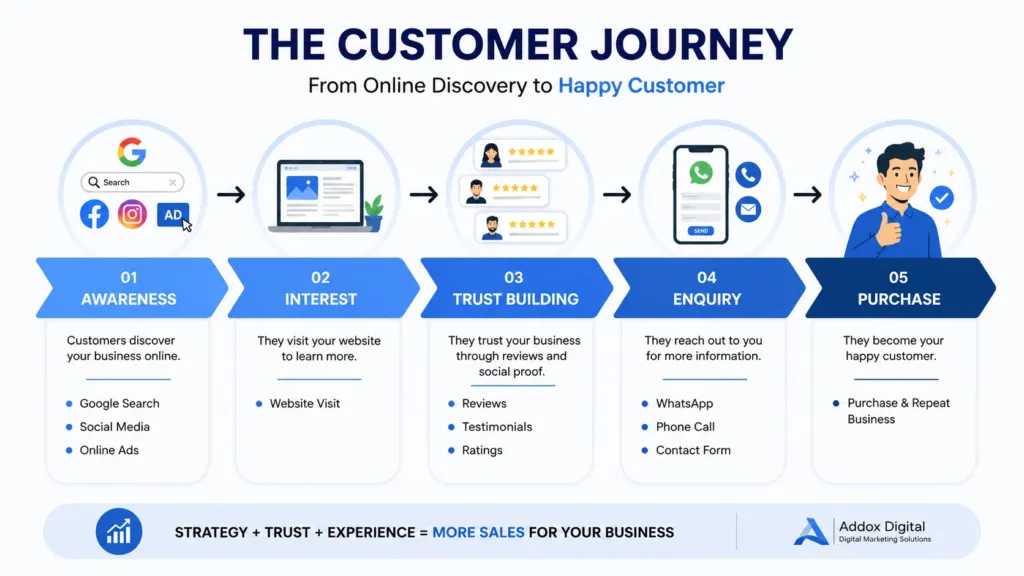
Create a Clear Customer Journey
A clear customer journey helps buyers move from first impression to enquiry without confusion or delay.
Many small businesses lose sales not because their products or services are poor, but because customers do not know what to do next.
Think about your business from the customer’s perspective.
A potential buyer might discover your business through Google, social media, a referral, or an advertisement. What happens after that first interaction?
Can they quickly understand your offer?
Can they find proof that your business is trustworthy?
Can they contact you without searching through multiple pages?
Can they get a response quickly?
Every step between discovery and purchase should feel simple and natural.
A clear customer journey typically includes:
- A clear explanation of the offer
- Trust-building elements such as reviews and testimonials
- Easy contact options
- A straightforward enquiry process
- Fast and helpful follow-up
When customers feel confused at any stage, they often leave and choose a competitor instead.
Businesses that regularly review and improve their customer journey often see better results without increasing their marketing budget.
What We Commonly See During Digital Marketing Audits
Many small businesses do not have a traffic problem; they have a conversion problem inside the buying journey.
During website and marketing audits, one observation appears repeatedly.
Businesses often believe they have a traffic problem when they actually have a conversion problem.
In many cases:
Traffic is arriving.
Enquiries are being generated.
Interest exists.
But the buying process breaks somewhere in the middle.
Common findings include:
- Confusing homepage messaging
- Weak calls to action
- Missing reviews
- Poor mobile experience
- Slow response times
- No lead tracking system
When these issues are fixed, businesses frequently experience better results without increasing their marketing budget.
This is why sales improvement often starts with optimization rather than expansion.
Activity vs Sales Gap Audit
What Looks Active | What May Be Missing | Sales Impact |
Regular social media posts | No clear offer or customer problem | People engage but do not enquire. |
Paid advertisements | Weak landing page or wrong audience | Clicks increase, but sales stay low. |
Updated website | Poor mobile experience or hidden contact options | Visitors leave without taking action. |
Good engagement | No trust signals or proof | Customers compare and choose competitors. |
Enquiries coming in | Slow response or no follow-up system | Interested leads lose confidence. |
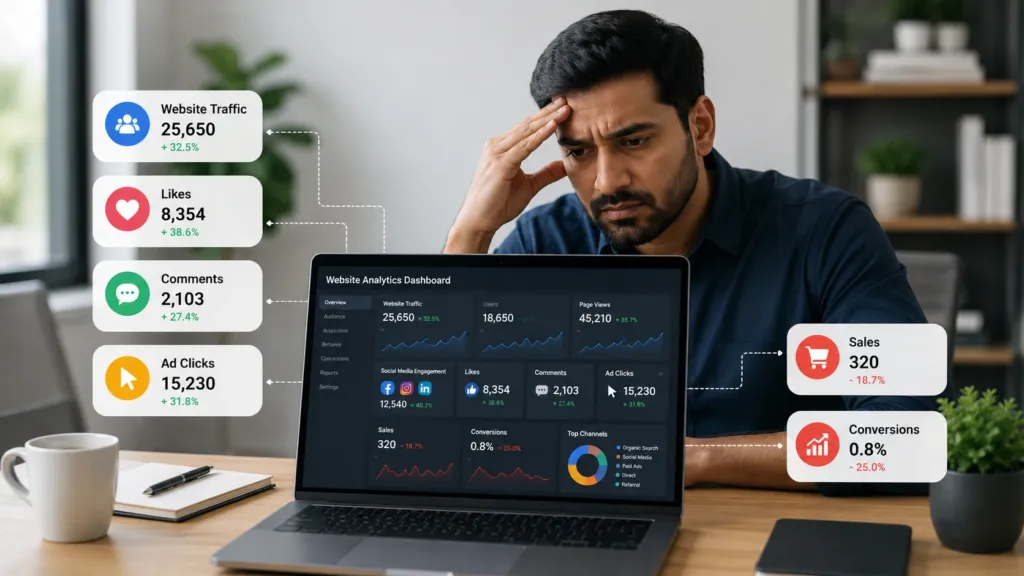
Why Customers Engage But Don’t Buy
High engagement does not guarantee sales. Customers buy only when they trust the business, understand the offer, and feel confident about taking the next step.
Many business owners become frustrated when they receive likes, comments, shares, and website visits but see little impact on actual sales.
At first glance, high engagement appears to be a positive sign. It suggests that people are noticing your business and interacting with your content. However, engagement and sales are not the same thing.
Engagement measures attention. Sales require commitment.
A customer may like your post, watch your video, visit your website, or even follow your page without being ready to make a purchase. Before taking the next step, most people need answers to important questions:
- Is this product or service right for me?
- Can I trust this business?
- What does it cost?
- What happens after I enquire?
- How quickly will I receive a response?
If these questions remain unanswered, interest often fades before a buying decision is made.
Many businesses mistakenly assume that engagement automatically leads to revenue. In reality, people engage with content for many reasons. They may be researching options, comparing competitors, gathering information, or simply finding the content useful. Engagement indicates interest, but interest alone does not guarantee a sale.
Before spending money, customers usually evaluate risk. They look for reviews, testimonials, proof of results, pricing clarity, and signs that the business can genuinely solve their problem. The more uncertainty they feel, the less likely they are to move forward.
This is why businesses should focus on more than vanity metrics such as likes, shares, and comments. More meaningful indicators include enquiries, phone calls, form submissions, bookings, consultations, and completed purchases. These metrics provide a clearer picture of whether marketing efforts are contributing to business growth.
The goal of content is not simply to attract attention. Its real purpose is to answer questions, build confidence, reduce uncertainty, and make the buying decision easier. When customers clearly understand the value of your offer and trust your business, engagement becomes far more likely to turn into enquiries and sales.
Why Unclear Messaging Reduces Sales
Clear messaging helps customers decide faster; vague messaging creates confusion and delays purchase decisions.
Customers make decisions quickly. If your message feels vague, many visitors leave before understanding your value.
One of the most common mistakes small businesses make is assuming that customers already understand what they offer. In reality, most visitors are seeing your business for the first time. They do not know your process, your expertise, or how your service can help them.
Common examples of unclear messaging include:
- “Best quality service”
- “Complete solutions”
- “Trusted experts”
- “Professional team”
While these phrases sound positive, they do not tell customers anything meaningful about your business. They fail to explain who the service is for, what problem it solves, or what result the customer can expect.
Specific messaging performs much better because it removes uncertainty.
Instead of saying:
“We provide digital marketing services.”
Say:
“We help local businesses generate more enquiries through SEO, Google Ads, and conversion-focused websites.”
The second statement immediately answers three important questions:
Who is the service for?
What service is provided?
What outcome can the customer expect?
This makes it easier for potential customers to decide whether your business is relevant to their needs.
Think about it from a customer’s perspective. When people visit a website, they are often looking for quick answers. They want to know:
Is this business right for me?
Can they solve my problem?
Why should I trust them?
What should I do next?
If your message does not answer these questions, visitors may leave and continue comparing other businesses.
A useful approach is to review your homepage, service pages, and social media profiles. Ask someone unfamiliar with your business to spend 10 seconds looking at your content. Then ask them:
What does this business do?
Who is it for?
What result does it provide?
If they struggle to answer, your messaging may need improvement.
The goal of good messaging is not to sound impressive. The goal is to make your value easy to understand.
Specificity builds confidence. Vagueness creates confusion. And confused customers rarely become paying customers.
Why Website Traffic Often Fails to Become Enquiries
A website must guide visitors toward action; traffic alone does not create enquiries.
A website should guide visitors toward action.
Unfortunately, many small business websites focus more on appearance than conversion.
Common problems include:
- Slow loading speed
- Unclear headlines
- Weak mobile experience
- Hidden contact options
- Missing reviews
- Long enquiry forms
- No pricing guidance
- No clear next step
Visitors usually decide within seconds whether they want to continue exploring.
If they cannot understand your offer quickly, they leave.
A beautiful website that fails to convert is still a poor-performing website.
Five Critical Factors That Turn Interest Into Sales
Improving these five areas helps businesses turn more attention, traffic, and enquiries into sales.
CLEAR Area | What It Means | Why It Matters |
Clarity | Customers immediately understand what you offer, who it is for, and the value it provides. | Confused visitors rarely become customers. Clear messaging increases enquiries and conversions. |
Lead Quality | Your marketing reaches people who are most likely to need, afford, and purchase your product or service. | Better-qualified leads result in higher conversion rates and less wasted marketing effort. |
Evidence | Customers see proof that your business can deliver results. | Reviews, testimonials, and case studies reduce risk and build trust. |
Accessibility | Customers can easily contact you and take the next step. | Friction in the enquiry process often causes potential customers to leave. |
Response Speed | Enquiries receive fast, helpful, and consistent responses. | Quick responses improve customer confidence and reduce lost opportunities. |
When More Posts Were Not the Solution
More content is not always the solution; sometimes the fastest sales improvement comes from fixing clarity, trust, and follow-up.
During a marketing review, a local service business appeared highly active online.
The business:
- Posted regularly
- Ran advertisements
- Updated its website
- Generated website traffic
Despite this activity, enquiries remained low.
After reviewing the customer journey, several issues became clear.
The homepage did not clearly explain who the service was for.
Reviews were difficult to find.
The enquiry process required too many steps.
WhatsApp responses were inconsistent.
Instead of creating more content, the business focused on improving clarity, trust, and follow-up.
Within weeks, enquiry quality improved because customers could understand the offer more easily and receive faster responses.
The lesson was simple.
More activity was not the answer. A better customer journey was.
Frequently Asked Questions
Start by improving your message, trust signals, website experience, and follow-up process. Many businesses can increase conversions before increasing traffic.
Likes indicate attention. Sales require trust, clarity, and buying intent. If your content does not answer customer questions, engagement may not turn into revenue.
Improve the first screen visitors see on your website. It should clearly explain your offer and provide an obvious next step.
Yes. Reviews reduce uncertainty and help customers feel more confident about choosing your business.
Conversion comes first. More content will not fix a confusing offer. First make your message, website, proof, and enquiry process clear.
Small business sales improve when common buyer doubts are answered before the customer leaves or compares competitors.
Many small businesses focus on getting more traffic, creating more content, and running more advertisements. However, sales usually improve when customers can easily understand the offer, trust the business, and take the next step without confusion.
Before investing more in marketing, review your customer journey. Look for areas where customers may be losing confidence, facing uncertainty, or struggling to take action.
When your message is clear, trust is visible, and the buying process is simple, marketing becomes more effective and sales become easier to generate.
The businesses that grow consistently are not always the busiest online. They are often the businesses that make it easiest for customers to say yes.
Sales growth often comes from improving the buying experience, not simply increasing marketing activity.
Getting Traffic But Not Enough Sales?
Discover what's stopping visitors from becoming customers.
Request a Sales Audit →