If your enterprise growth depends on luck, you don’t have a strategy—you have a risk.
Many businesses rely on one viral campaign, one top salesperson, or one lucky quarter. But sustainable growth doesn’t come from spikes—it comes from systems.
A well-built Marketing Machine helps you generate consistent leads, align your sales process, and create predictable revenue.
What is a Marketing Machine?
A Marketing Machine is a structured, repeatable system that:
✓ Attracts the right audience
✓ Nurtures leads through a funnel
✓ Converts prospects into customers
✓ Improves performance using real data
Instead of guessing what works, you build a system that works consistently.
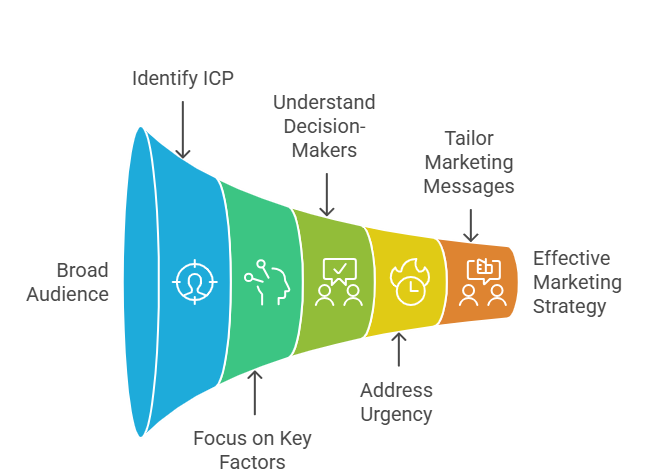
1. Define Your Ideal Customer Profile (ICP)
You cannot scale if you target everyone.
A strong enterprise marketing strategy starts with identifying the right audience.
Focus on:
✓ Industry, company size, and revenue
✓ Tech stack and business model
✓ Decision-makers and buying committee
✓ Urgency of the problem you solve
Enterprise deals involve multiple people:
✓ Decision Maker (CEO/CFO)
✓ Internal Champion
✓ IT/Technical Team
✓ End Users
Your marketing must speak to all of them.
2. Build a Full-Funnel Marketing System
Most companies only focus on awareness. That’s why they struggle to convert.
You need a complete funnel.
Top of Funnel (Awareness)
Goal: Attract traffic and educate
✓ SEO blogs
✓ Industry insights
✓ Educational content
Middle of Funnel (Consideration)
Goal: Build trust and validate solution
✓ Webinars
✓ Comparison guides
✓ Email nurturing
Bottom of Funnel (Decision)
Goal: Convert leads into customers
✓ Case studies
✓ ROI breakdown
✓ Demo or consultation pages
A strong funnel ensures that leads move step-by-step towards conversion.
3. Implement Lead Scoring System
Not every lead is ready to buy.
Without proper qualification, your sales team wastes time.
Track Two Types of Signals:
Implicit (Behavior):
✓ Website visits
✓ Content downloads
✓ Page engagement
Explicit (Data):
✓ Job role
✓ Company size
✓ Purchase intent
Important Rule:
Only send qualified leads (MQLs) to sales.
This improves conversion rate and reduces wasted effort.
4. Track the Right Metrics
Traffic alone doesn’t grow your business. Revenue does.
Focus on:
✓ Customer Acquisition Cost (CAC)
How much you spend to acquire a customer
✓ Lifetime Value (LTV)
Total revenue from a customer
✓ Conversion Velocity
How fast a lead becomes a customer
Tracking these metrics helps you move from guessing to predicting.
5. Continuous Optimization (Growth Loop)
A marketing machine improves over time.
Ask:
✓ Which channels bring quality leads?
✓ Which content converts best?
✓ Where do leads drop off?
Optimize by:
✓ Increasing budget on high-performing channels
✓ Improving low-performing pages
✓ Testing headlines and CTAs
This turns marketing from a cost into a profit center.
Implementation Plan
Week 1–2
✓ Define ICP
✓ Setup tracking tools
✓ Identify target accounts
Week 3–5
✓ Create SEO content
✓ Build funnel pages
✓ Start lead generation
Week 5–7
✓ Add lead scoring
✓ Improve CTAs
✓ Align marketing and sales
Ongoing
✓ Track performance
✓ Optimize campaigns
✓ Scale what works
Common Mistakes to Avoid
✗ Targeting everyone
✗ No funnel strategy
✗ Ignoring lead qualification
✗ Weak CTAs
✗ Not tracking performance
Conclusion
Enterprise growth is not about luck—it’s about systems.
When you combine:
✓ Clear audience targeting
✓ Full funnel marketing
✓ Lead qualification
✓ Data-driven decisions
You create a predictable growth engine.
FAQ
What is an enterprise marketing strategy?
A structured approach to generate, nurture, and convert high-value business customers.
What is a marketing machine?
A repeatable system that generates consistent leads and revenue.
Why is ICP important?
It helps target the right customers and improves conversion rates.
How do you generate enterprise leads?
Using SEO, content marketing, paid ads, and lead nurturing systems.
What metrics matter most?
Customer Acquisition Cost (CAC), Lifetime Value (LTV), and Conversion Speed.
Ready to Build Your Marketing System?
Start by fixing your data, content, and funnel strategy today.
👉 Build systems.
👉 Track performance.
👉 Scale predictably.